3. Motivational Determinants of Continuing Education Effectiveness in the Republican Police
In an institutional context seeking effectiveness, officers' adherence to continuing education programs cannot be limited to administrative injunctions or hierarchical obligations. It also, and above all, rests on a set of incentive factors that generate interest, stimulate motivation, and encourage voluntary engagement in the learning process. Understanding these factors is essential for designing training programs that are simultaneously attractive, accessible, and meaningful for Republican Police officers.
Table 1. Perception of the Influence of Professional Recognition.
Modality | N | Percentages |
Not at all influential | 18 | 5.00 |
Minimally influential | 43 | 11.94 |
Moderately influential | 70 | 19.44 |
Influential | 103 | 28.61 |
Very influential | 126 | 35.00 |
Total | 360 | 100.00 |
Source: Field data, 2024-2025
The results show a very favorable trend toward professional recognition as a lever for motivating participation in continuing education. Indeed, nearly 85% of officers consider this recognition to be very influential or influential, while the other segment deems it minimally or not at all influential. This confirms that professional recognition is perceived as an essential factor in the dynamic of continuous skill improvement. This opinion was reinforced by a trainer who stated the following:
When an officer knows that their training efforts will be recognized, they become more diligent, more engaged. Recognition, even symbolic, values the act of learning and strengthens the will to train.
Expert10, Field Data, 2024-2025
This expert emphasizes the importance of professional recognition for the diligence and engagement of police officers in a training context. Similarly, another adds:
It is clear that intrinsic motivation is not always enough. When professional recognition is integrated into the HR strategy, officers perceive continuing education as an opportunity for progression and not as an obligation.
Expert 13, Field Data, 2024-2025
Through these statements, it is observed that the idea of professional recognition creates a potential change in police officers' perception of continuing education. Indeed, the idea of this recognition leads them to view continuing education as an opportunity and not merely as a constraint from the hierarchy. In the same sense, a hierarchical leader commented:
The officers who receive positive feedback after training – a commendation, a strategic assignment, a simple congratulations – are the ones who invest themselves more. This recognition creates a dynamic of skill valuation.
Hierarchical Leader 07, Field Data, 2024-2025
The hierarchical leader highlights that the officers most invested in training are those who receive post-training recognition, which confirms the catalytic role of valuations in their diligence. The analysis shows that professional recognition – whether symbolic or linked to career opportunities – constitutes an essential lever of motivation, far more decisive than personal motivation alone. Thus, to ensure lasting engagement and maximize the impact of acquired skills, it is essential to institutionalize visible and equitable recognition mechanisms at the heart of the continuing education system.
DJOGBENOU
emphasize the role of organizational recognition as a motivational lever. Without clear valuation of training efforts (promotion, progression, visibility), officers risk perceiving training as an administrative obligation rather than a strategic investment in their career,
| [9] | [DJOGBENOU Joseph, 2014, “The constitutional review of court decisions: just another fantasy?”, Afrilex Review. |
[9]
. This finding is perfectly consistent with the conclusions of the Quebec security service report, which highlights a generational shift in police officers' expectations,
| [23] | QUEBEC SECURITY SERVICE, 2020. 2020 Annual Report. Quebec City, Canada : Government of Quebec. |
[23]
. The report emphasizes that recruits aspire to a better balance between professional commitment, quality of life, and recognition of developed competencies. The focus is placed not only on valuing technical know-how but also on human and relational skills, deemed essential to the evolution of a police career. Thus, recognition should not be limited to symbolic retribution but should translate into concrete valuation mechanisms, such as access to positions of responsibility, mobility prospects, or consideration in the annual evaluation.
Furthermore, the report recommends integrating the human dimension as a central criterion in selection and promotion processes, which calls for a redefinition of police excellence standards beyond mere technical aptitude. This perspective aligns with the aspirations of the Beninese officers interviewed, who express a strong need for institutional recognition of their competencies, both technical and behavioral. In short, the motivation to train is inseparable from the organizational climate, the culture of recognition, and the way in which acquired skills are integrated into the professional journey. Officers' engagement in continuing education programs cannot be fully understood without considering the central role of institutional recognition. Beyond the training offered, it is the organizational climate and human resource management policy that condition the staff's lasting motivation to train. A training program, however relevant, loses its appeal when it is not accompanied by a visible and tangible valuation system.
In their analysis, GAGNE & FOREST stress that police officers' adherence to professionalization initiatives largely relies on the recognition of fundamental professional attitudes and values, such as loyalty, sense of duty, rigor, and integrity,
| [12] | GAGNE Marylène & FOREST Jacques. (2008). The motivation at work scale: Validation evidence in two countries. Journal of Organizational Behavior, 29(6), 733–756. |
[12]
. These authors insist that these attitudes cannot be developed or maintained long-term in the absence of a favorable organizational environment that values the efforts made by officers, both in the daily exercise of their duties and in their training endeavors. Thus, when training is not articulated with clear internal mobility, promotion, or career advancement policies, it tends to be perceived as an administrative obligation, or even a waste of time. This disconnect between personal investment in training and the absence of real recognition generates frustration, disengagement, or even passive resistance. Conversely, an institution that integrates continuing education into a global human resources development strategy sends a strong signal to officers: that their skill development is valued, useful, and provides concrete career prospects. Consequently, to strengthen the motivation to train, it is not enough to offer quality content: it is also necessary to build a coherent institutional ecosystem where training is part of an evolving professional journey. This implies setting up formal recognition mechanisms (certifications, bonuses, advancements) but also daily managerial practices that value training efforts as acts of commitment to public service. In this logic, training ceases to be a simple tool for knowledge transmission and becomes a vector for legitimization, progression, and professional valuation.
After addressing the influence of professional recognition following training sessions, the following table focuses on the perceived influence of financial incentives on the motivation to participate in organized continuing education sessions.
Table 2. Perception of the Influence of Financial Incentives.
Modality | N | Percentages |
Not at all influential | 31 | 8.61 |
Minimally influential | 41 | 11.39 |
Moderately influential | 81 | 22.50 |
Influential | 124 | 34.44 |
Very influential | 83 | 23.06 |
Total | 360 | 100.00 |
Source: Field data, 2024-2025
The analysis shows that financial incentives motivate a majority of officers, but their effect remains unequal, with nearly 42% judging their influence to be moderate, low, or non-existent. This reveals that, although real, extrinsic motivations are not sufficient to ensure lasting engagement in continuing education. Bonuses act as a trigger but do not guarantee either the regularity or the depth of involvement. To strengthen adherence, they must be complemented by more sustainable levers, such as symbolic recognition, professional development, a stimulating work environment, and firm hierarchical support. A multi-factor approach to motivation thus appears indispensable for fostering sustainable skill development.
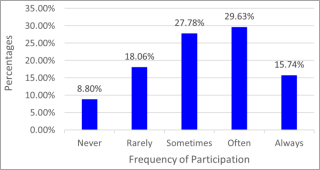
The following figure presents the frequency of participation in continuing education sessions due to the existence of professional recognition systems.
Figure 1. Frequency of Participation Due to Professional Recognition.
The police officers questioned who had participated at least once in a continuing education session affirmed at a rate of 29.63% that they frequently participated in the said sessions due to the existence of professional recognition at their conclusion. From a global perspective, it is observed that nearly 75% of police officers generally participate in sessions because they know that recognition is at stake. While this finding may legitimate a conclusion favoring the dominance of the extrinsic nature of police officers' motivation concerning continuing education sessions, it is important to keep in mind that they may be in a situation of dual motivation where intrinsic factors are reinforced by extrinsic ones. This translates into an ambivalent relationship: although some police officers are motivated by purpose, passion for the job, or the desire for self-improvement, continuing education remains largely perceived as a functional tool rather than a space for personal development. A trainer indicates:
Even if officers do not always express it openly, those who spontaneously return for training often have a thirst for learning and a personal will to do their job better.
Expert 03, field data, 2024-2025
He thus draws attention to the existence, albeit presumably passive, of intrinsic determinants underlying the desire and decision to participate in continuing education sessions. A Human Resources officer, for his part, emphasizes:
In career interviews, we see that some seek to progress not only to obtain a rank, but also to feel more useful, more competent. It is a form of self-fulfillment that, without being the majority, does exist.
HR Officer 03, Field Data, 2024-2025
Through these comments, an aspect sometimes overlooked in the reasons underpinning the interest given to continuing education sessions by police officers is noted. Indeed, according to this Human Resources manager, there are police officers who nurture a great interest in the said sessions because they want to be more competent in order to better serve the force and, by extension, the Republic. Thus, although continuing education produces effects at their level as individuals, they also see the interest of the institution and the population in their skill growth. Another manager adds the following:
It is often the same profiles that actively engage: those who believe in their profession and want to progress in the exercise of their duties. Even if it is not the majority, their presence is valuable and should be encouraged.
HR Officer 02, Field Data, 2024-2025
The results indicate that, even if intrinsic motivation is not the majority, it remains present among a significant number of officers who see training as an opportunity to progress and give greater meaning to their mission. This dynamic shows that beyond material incentives, some police officers are motivated by the desire for excellence, technical mastery, and personal development. This constitutes a strategic opportunity for decision-makers: by integrating dimensions that value the purpose of the profession, professional pride, and individual accomplishment, training programs can stimulate a form of engagement that is more lasting and less dependent on external rewards. Encouraging intrinsic motivation would thus make it possible to strengthen not only technical skills but also a culture of excellence and initiative, which is essential for the overall performance of the Republican Police.
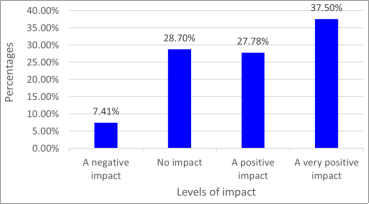
Following this assessment concerning the influence of professional recognition and motivation on the frequency of participation, the following figure presents the results regarding the impact of financial incentives on involvement and performance during continuing education sessions.
Figure 2. Impact of Financial Incentives on Involvement and Performance.
According to 37.50% of police officers who have already participated in a continuing education session, financial incentives have a positive impact on their involvement and performance during the training sessions. This impact is described as very positive by 26.39% of respondents, while 28.70% consider the said incentives to have no impact. However, although their proportion is relatively small, 7.41% of respondents affirmed that financial incentives have a negative impact on their involvement and performance during continuing education sessions. Thus, they believe that the absence of financial incentives for continuing education sessions inhibits their involvement. Still in the quest for motivational elements at work, the following figure presents the results regarding the influence of career progression opportunities on the motivation to participate in training sessions.
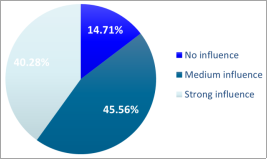
Figure 3. Influence of Career Progression Opportunities on the Choice to Participate.
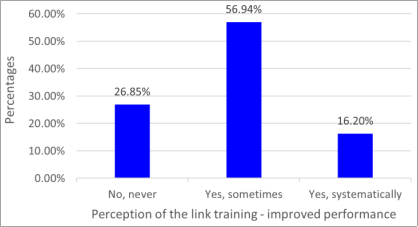
The vast majority of police officers questioned recognize a certain influence of career progression opportunities on the decision to participate in the continuing education sessions organized by the Republican Police. Thus, in addition to financial incentives and motivation through professional recognition, the knowledge of career progression opportunities are elements that moderate not only the decision to participate but also the involvement and performance of police officers during the organized continuing education sessions. The following figure addresses the observation of a link between continuing education sessions and the improvement of operational effectiveness among the police officers questioned.
Figure 4. Observation of Performance Improvement Following Training Sessions.
The results show that the majority of Republican Police officers perceive a direct link between their participation in continuing education and their operational performance in the field. 56.94% of officers sometimes noted a link between their training and their performance, while the observation is systematic for 16.20% and non-existent for 26.85%. This indicates an acknowledgement that training can contribute variably to improving operational performance.
The importance of professional recognition identified in the results aligns with BRUN & DUGAS, who established that recognition at work operates on four registers: existential (recognition of the person), practical (recognition of efforts), ethical (recognition of investment), and results (recognition of achievements),
| [4] | BRUN Jean Pierre, & DUGAS Ninon. (2008). An analysis of employee recognition: Perspectives on human resources practices. The International Journal of Human Resource Management, 19(4), 716–730. |
[4]
. Their research demonstrated that existential and practical recognition particularly influences intrinsic motivation, while results recognition affects extrinsic motivation more. The results suggest a predominance of results recognition (commendations, strategic assignments, promotions), to the detriment of the other registers. This asymmetry may explain why motivation remains largely extrinsic: officers are recognized for what they have accomplished (successful training) rather than for who they are (committed professionals) or for their effort (investment in learning). A rebalancing toward more diversified forms of recognition could favor the emergence of more intrinsic and sustainable motivations. SERGIO & HAL showed that social recognition (positive feedback, public congratulations) produces motivational effects comparable to monetary rewards, while generating much lower costs,
| [22] | STAJKOVIC Alexander, & LUTHANS Fred, (2003). Behavioral management and task performance in organizations: Conceptual background, meta-analysis, and test of alternative models. Personnel Psychology, 56(1), 155–194. |
[22]
. The authors demonstrate that the effect of recognition on performance is mediated by three psychological mechanisms: increased feeling of competence, strengthening of the feeling of belonging (relatedness), and satisfaction of the need for esteem. These conclusions suggest that the Beninese institution could optimize its investments by developing structured and equitable systems of symbolic recognition, thus supplementing material incentives. GRANT
provides additional insight into the mechanisms by which recognition influences motivation,
| [14] | GRANT Adam. (2008). Does intrinsic motivation fuel the prosocial fire? Motivational synergy in predicting persistence, performance, and productivity. Journal of Applied Psychology, 93(1), 48–58. |
[14]
. The author demonstrates that recognition is particularly effective when it is specific (relating to precise behaviors or achievements), authentic (perceived as sincere), and socially visible (known to peers and the hierarchy). The informal and discretionary recognition practices mentioned in the Beninese context violate these principles of effectiveness, explaining why their motivational potential is only partially realized.
The predominance of extrinsic motivations (recognition, financial incentives, career progression) can be analyzed through the Cognitive Evaluation Theory,
| [7] | DECI Edward et RYAN Richard, 1985, Intrinsic Motivation and Self-Determination in Human Behavior, New York, Plenum Press. |
[7]
. This theory establishes that external rewards can either support or undermine intrinsic motivation, depending on whether they are perceived as informational (confirming competence) or controlling (imposing a behavior). The results show that current reward systems function more in a controlling mode: officers participate in training to obtain external benefits rather than out of genuine interest. This dynamic generates extrinsic motivation that is, at best, integrated and, at worst, identified, according to the taxonomy,
| [7] | DECI Edward et RYAN Richard, 1985, Intrinsic Motivation and Self-Determination in Human Behavior, New York, Plenum Press. |
[7]
. In integrated motivation, the officer recognizes the instrumental value of the training for their career goals and integrates it into their professional identity. In identified motivation, they participate because they deem it important to progress, without finding an intrinsic interest in it.
GAGNE & FOREST demonstrate that the shift from controlling forms to autonomous forms of extrinsic motivation depends on three organizational conditions: perceived autonomy in training choices, clarity of the link between training and authentic professional development, and the quality of relationships with supervisors,
| [12] | GAGNE Marylène & FOREST Jacques. (2008). The motivation at work scale: Validation evidence in two countries. Journal of Organizational Behavior, 29(6), 733–756. |
[12]
. The case of the Republican Police exhibits fragilities on these three dimensions: autonomy limited by discretionary selection practices, a sometimes opaque link between training and career, and heterogeneity of hierarchical support. Cognitive Evaluation Theory also predicts that external over-justification can undermine emerging intrinsic motivations. When an intrinsically interesting activity is associated with salient external rewards, the individual may progressively attribute their engagement to the rewards rather than to intrinsic interest. This dynamic could explain the weakness of intrinsic motivation in the Beninese context: the institutional emphasis on statutory and financial benefits may have eroded pre-existing authentic motivations among some officers.
The variability in the perception of the training-performance link (only 16.20% systematically observe it) echoes research on transfer moderating factors. SERGIO & HAL identify three categories of moderators: individuals (self-efficacy, motivation, learning ability), pedagogical (methods, content, training quality), and organizational (application opportunities, support, transfer climate),
| [22] | STAJKOVIC Alexander, & LUTHANS Fred, (2003). Behavioral management and task performance in organizations: Conceptual background, meta-analysis, and test of alternative models. Personnel Psychology, 56(1), 155–194. |
[22]
. The authors establish that organizational factors explain 45% of the variance in perceived transfers, compared to 25% for pedagogical factors and 30% for individual factors. This distribution clarifies the results: even motivated officers who follow quality training do not perceive improvement if the organizational environment does not facilitate applications. The group of 26.85% never perceiving a link likely reflects this environmental constraint rather than a deficit in motivation or pedagogical competence. RYAN & DECI developed the Learning Transfer System Inventory (LTSI), an instrument measuring 16 factors influencing transfer,
. Among these factors, four emerge as particularly determining in hierarchical organizations like police forces: supervisor support, performance consequences (recognition of successful applications), feedback on the application, and organizational change openness. The results reveal substantial deficiencies in these four dimensions, explaining the limited perception of the training-performance link. GRANT for his part, establish that the perception of the training-performance link reciprocally influences future motivation to train,
| [14] | GRANT Adam. (2008). Does intrinsic motivation fuel the prosocial fire? Motivational synergy in predicting persistence, performance, and productivity. Journal of Applied Psychology, 93(1), 48–58. |
[14]
. Officers who observe improvements develop a positive expectation regarding the benefits of subsequent training, strengthening their engagement. Conversely, those who perceive no benefit develop a negative expectation leading to disengagement. This circular dynamic suggests that improving transfer conditions is not only an issue of immediate effectiveness but also an investment in long-term motivation.
In a comparative approach, SERGIO & HAL analyzed the evolution of police culture in different national contexts. The author identified two trajectories: a traditional trajectory maintaining a corporatist, hierarchical, and change-averse culture, and a reformed trajectory developing a professional, learning, and continuous improvement-oriented culture,
| [22] | STAJKOVIC Alexander, & LUTHANS Fred, (2003). Behavioral management and task performance in organizations: Conceptual background, meta-analysis, and test of alternative models. Personnel Psychology, 56(1), 155–194. |
[22]
. The results suggest an intermediate position: the unanimous recognition of the importance of training testifies to an openness to change, but the predominance of extrinsic motivations and the persistence of structural obstacles indicate that the cultural transformation remains incomplete. ERAUT in her work on police culture change, insists on the determining role of the organizational field (material conditions, managerial practices, reward systems) in the transformation of professional
habitus (values, attitudes, dispositions),
| [10] | ERAUT Michael, 2004, Informal learning in the workplace. Londres, Routledge. |
[10]
. She demonstrates that training initiatives cannot permanently modify practices if they are not accompanied by changes in the field: improvement of working conditions, evolution of evaluation criteria, transformation of command styles. This analysis clarifies the limitations of the system in place in the Republican Police: training generates new knowledge (potential
habitus) that does not translate into new practices due to the lack of transformation in the field (constraining environment).
The critique of content standardization and the claim for differentiation by service are grounded in the situated learning theories developed by GRANT,
| [14] | GRANT Adam. (2008). Does intrinsic motivation fuel the prosocial fire? Motivational synergy in predicting persistence, performance, and productivity. Journal of Applied Psychology, 93(1), 48–58. |
[14]
. These authors establish that effective learning occurs in and through participation in the practices of a specific community of practice. It does not consist of an abstract transmission of general knowledge but of a progressive socialization into the ways of doing, thinking, and solving problems specific to a field of activity. This theoretical perspective implies that police training should be differentiated according to the communities of practice: judicial police, crowd control, community policing, intelligence, etc. Each possesses its own challenges, its own tacit knowledge, and its own criteria for excellence. Uniform training cannot adequately respond to this diversity, generating the feeling of inadequacy observed in the results.
BRUN & DUGAS
deepen this analysis by distinguishing canonical knowledge (formal knowledge and official procedures) from non-canonical knowledge (effective practices and professional tricks of the trade),
| [4] | BRUN Jean Pierre, & DUGAS Ninon. (2008). An analysis of employee recognition: Perspectives on human resources practices. The International Journal of Human Resource Management, 19(4), 716–730. |
[4]
. They demonstrate that effective learning requires not only the transmission of canonical knowledge but, above all, access to non-canonical knowledge through immersion in real work situations. Standardized training tends to prioritize canonical knowledge, neglecting the contextual and tacit knowledge that makes the difference between a competent officer and an excellent one. Furthermore, ERAUT demonstrates that the most critical competencies develop through three modalities: implicit learning (non-conscious observation and participation), reactive learning (rapid adaptation to situations), and deliberative learning (structured reflection on experience),
| [10] | ERAUT Michael, 2004, Informal learning in the workplace. Londres, Routledge. |
[10]
. Continuing education should integrate these three modalities by alternating exposure to structured content, realistic scenario setting, and reflective coaching. The current standardization favors deliberative learning to the detriment of the other two modalities, limiting the development of robust operational competencies.
The cross-analysis of the results and their confrontation with the literature reveal that the effectiveness of continuing education in the Republican Police of Benin fundamentally depends on complex motivational factors, articulating extrinsic dimensions (recognition, incentives, career) and intrinsic dimensions (personal development, sense of purpose). The current predominance of extrinsic motivations, while understandable in the Beninese institutional context, limits the durability and depth of engagement in learning.
4. Challenges of Continuing Education in the Republican Police
While continuing education represents an essential lever for developing professional skills and improving operational performance within the Republican Police, its implementation continues to face numerous challenges. Despite institutional efforts to structure and generalize these training programs, several constraints limit their actual effectiveness in the field. These obstacles can be material, organizational, psychological, or institutional, and vary depending on the intervention contexts, the profiles of the officers, and the pedagogical modalities employed.
In light of the various elements highlighted in the preceding sections, it is appropriate to address the challenges facing continuing education within the Republican Police,
| [20] | RYAN Richard & DECI Edward, 2000, Self-Determination Theory and the Facilitation of Intrinsic Motivation, Social Development, and Well-Being. |
[20]
. On this subject, a trainer commented in the following terms:
First, limited resources pose a significant problem. Restricted budgets and lack of resources can limit the frequency, quality, and access to training. Moreover, it is often difficult to free up time for training without disrupting daily operations, as officers are frequently engaged in urgent missions. Adapting programs to local realities is also a challenge. Each region has its cultural specificities and specific types of criminality, which require tailored content and approaches. The lack of adequate infrastructure and limited access to modern technologies can also hinder the effectiveness of training, particularly those using advanced digital tools.
Expert 06, Field Data, 2024-2025
The analysis shows that training within the Republican Police of Benin is severely limited by insufficient financial resources, which affects the regularity, quality, and modernization of the modules. Operational constraints worsen the situation: reduced and constantly mobilized staff make it difficult for officers to be available for continuous training. The content, often standardized, does not sufficiently consider regional realities and the specific needs related to the diversity of the country's security contexts. Added to this are a lack of modern infrastructure and limited access to digital technologies, which hinders distance learning and skill updates. To be truly effective, training must be rethought by strengthening resources, adopting flexible and better contextualized mechanisms, and investing in modern and accessible pedagogical tools. In the same vein, a hierarchical leader stated:
Limited budgets can restrict the quality, frequency, and diversity of available training, as well as access to modern technologies. The lack of appropriate training facilities, such as simulation centers and computer labs, can limit the effectiveness of training programs. Training must constantly adapt to new threats, which can be difficult to keep up with continuously and effectively. Ensuring that training is relevant and adapted to the specific needs of each region or specialized unit can be complex.
Hierarchical Leader 07, Field Data, 2024-2025
The hierarchical leader asserts that it is difficult to adapt continuing education to the specific needs of regions and units, but this position requires nuance. Indeed, while initial training must remain uniform, continuing education must, on the contrary, respond to the very diverse operational realities on the ground. Security challenges differ greatly between urban, rural, or border areas, and according to specialized units. Uniform training thus becomes disconnected from real needs and practically useless. Conversely, differentiating content according to contexts would enhance the relevance, motivation, and performance of the officers. This adaptation is not complex: it relies on local needs analysis, the participation of unit leaders, and the design of targeted modules. Many African countries already demonstrate the feasibility of modular training adapted to regional realities. Addressing the issue of officer motivation, a trainer maintains that:
Generating officer engagement and motivation to actively participate in training programs is another difficulty. Some officers may view training as an interruption of their daily work rather than a development opportunity. Establishing robust systems to evaluate and monitor acquired skills is also crucial but complex, as it is essential to measure the actual impact of training on officers' operational performance.
Expert09, Field Data, 2024-2025
Continuing education struggles to mobilize Republican Police officers in Benin, mainly because it is not perceived as a real lever for professional advancement. Unlike degree-granting training, which is highly valued, technical or behavioral training is judged to be poorly recognized and insufficiently linked to career progression. This situation reveals a structural imbalance that hinders engagement and underscores the need to strengthen incentives: official recognition, bonuses, consideration in evaluations, or access to professional gateways. Added to this is the absence of robust evaluation systems to measure the impact of training, which fuels officer skepticism. Operational constraints, pressure on staffing, and a hierarchical culture not very open to expressing needs further complicate participation. To overcome these obstacles, reform is necessary: concretely value continuing education, diversify pedagogical formats, and clearly articulate skill development with statutory progression. A hierarchical leader adds this:
It can be difficult to motivate all officers to actively and regularly participate in continuing education programs, especially in cases of heavy workload or lack of recognition of immediate benefits.
Hierarchical Leader 08, field data, 2024-2025
The hierarchical leader's statement primarily reveals the disengagement of the hierarchy, whose lack of involvement weakens officer motivation and sends the message that training is not a priority. This withdrawal undermines the impact of continuing education, because without active hierarchical support to accompany, value, and integrate training into team management, officers' disinterest becomes inevitable. It is therefore essential to refocus supervisors on their role as drivers of professionalization by clarifying their responsibilities, strengthening their own managerial training, and establishing recognition and evaluation mechanisms linked to training actions. For another trainer, program updates are a necessity:
Threats and technologies evolve rapidly, meaning that training programs must be continually updated to prepare officers for new challenges. Finally, integrating new technologies and strategies into law enforcement practices is often difficult due to resistance to change. This requires innovative pedagogical approaches to facilitate the adoption of new methods.
Expert 11, Field Data, 2024-2025
The trainer's comments complement those of the hierarchical leader by emphasizing that, beyond the lack of officer motivation, one of the main blockages lies in the growing inadequacy between training content and operational realities. This situation weakens the interest in training and increases disengagement if programs are not continuously updated to respond to new threats and technologies. The analysis thus highlights a dual responsibility: a hierarchy that must play an active mobilization role, and designers who must adapt the content. It also shows that the adoption of new pedagogical and organizational practices strongly depends on the involvement of supervisors, whose exemplary behavior conditions the acceptance of change by the officers.
The challenges identified by the respondents correspond to the classic obstacles to change management in public organizations analyzed by RYAN & DECI,
. These authors identify eight recurrent obstacles: insufficient resources, employee resistance, lack of management support, poor communication, unsuitable organizational structure, culture hostile to change, conflicts of priorities, and limited leadership capacity. The results attest to the presence of most of these obstacles. Limited resources affect the frequency and quality of training. Officer resistance is manifested in the perception of training as an interruption rather than an opportunity. The heterogeneous hierarchical support reveals unequal management commitment. Content standardization reflects an insufficiently flexible organizational structure. The difficulty in updating programs testifies to limited leadership capacity.
A particularly illuminating contribution is that of BAYLEY on policing reforms in developing countries. The author showed that training initiatives frequently fail because they are conceived as isolated technical interventions rather than as components of global institutional transformations,
| [2] | BAYLEY David, 2006, Changing the Guard: Developing Democratic Police Abroad, Oxford, Oxford University Press. |
[2]
. He demonstrates that the effectiveness of training depends on its articulation with: human resource management reforms (recruitment, evaluation, career), a transformation of command practices (toward more participation and support), the modernization of infrastructure and equipment, and a change in organizational culture (valuing learning). This systemic analysis aligns with the observations that the challenges are not limited to training itself but concern the institutional ecosystem as a whole. The persistence of obstacles despite the recognition of their importance suggests that they are not being addressed in an integrated but fragmented manner, limiting the effectiveness of ad hoc interventions.
5. Link to the Analytical Model
Deci and Ryan's Self-Determination Theory (SDT) posits autonomy as a fundamental psychological need whose satisfaction conditions the development of autonomous, intrinsic, and sustainable motivation,
| [8] | DESI Edward, & RYAN Richard. (2017). Self-determination theory: Basic psychological needs in motivation, development, and wellness. New York, NY: Guilford Press. |
[8]
. Autonomy does not mean total independence but a feeling of volition, the capacity to make choices aligned with one's values, and the perception of control over one's professional development. The results reveal a limited satisfaction of this need for autonomy. The predominance of professional recognition as a motivational determinant (63.61% influential or very influential) testifies to dependence on external validation rather than an autonomous regulation of engagement. Officers participate because they anticipate an institutional reward, not because they have freely chosen to develop themselves. This dynamic corresponds to what SDT calls external regulation, the least autonomous form of extrinsic motivation.
The cross-referencing with results on discretionary selection practices ("Superiors only send their own people") and insufficient hierarchical support (31.25% as a reason for non-participation) reveals direct violations of the need for autonomy. Officers do not have the necessary control over their access to training, creating a feeling of powerlessness and dependence on arbitrary hierarchical decisions. This frustration generates, according to SDT, either controlled motivation (participation to avoid sanctions or obtain approval) or amotivation (disengagement due to perceived lack of control). The minority of officers demonstrating intrinsic motivation (those who "spontaneously return," according to Expert03) likely testifies to an individual capacity to maintain an internal locus of causality despite an unfavorable organizational environment. These officers have succeeded in internalizing the value of training and perceiving it as a personal choice rather than an external obligation. Their presence demonstrates the potential for autonomous motivation, but their minority status reveals that organizational conditions do not favor its generalized development.
SDT predicts that satisfying the need for autonomy requires three organizational conditions: offering meaningful choices, providing a clear rationale explaining the importance of requested behaviors, and acknowledging individuals' perspectives and feelings. The Beninese context exhibits deficiencies in these three dimensions. Training choices remain limited by access constraints. The rationale for training is not always explicit, as officers do not always understand why certain content is imposed on them. Individual perspectives are insufficiently taken into account in the design of programs, as revealed by the unsatisfied demand for personalization. The need for competence, the second pillar of SDT, is manifested in the desire to feel effective, master one's tasks, and progress. The results testify to a strong aspiration for competence: 74.29% of officers hope for an improvement in their operational effectiveness, 68.57% for an increase in their ability to manage complexity. This aspiration constitutes fertile ground for the development of motivation, provided the environment effectively allows for the development of the feeling of competence.
However, the effective satisfaction of this need remains compromised by several factors. The variability in the perception of the training-performance link (only 16.20% systematically observe it, 26.85% never perceive it) suggests that many officers do not develop an increased sense of competence despite their participation in training. This absence of perceived improvement directly violates the need for competence, generating frustration and demotivation. The identified transfer obstacles explain this frustration. An officer trained in new techniques but unable to practice them (51.43%) cannot develop an authentic sense of mastery. The absence of post-training feedback (45.71%) deprives them of the information necessary to evaluate their progress and adjust their practices. The insufficiency of material resources (40%) creates a gap between potential competencies and effectively mobilizable competencies, undermining the sense of efficacy. SDT establishes that satisfying the need for competence requires optimally dosed challenges (neither too easy nor too difficult), opportunities for practice and progression, and constructive and informative feedback. The results reveal deficiencies in these three dimensions. Content standardization compromises the adaptation of the challenge levels to individual capacities. Organizational constraints limit practice opportunities. The lack of systematic follow-up mechanisms deprives officers of the necessary feedback. Nevertheless, some elements favor the satisfaction of the need for competence. Professional recognition, when specific and informative, confirms skill development. Practical training offers opportunities for experimentation and progressive mastery. The identified areas of need (crowd control techniques 62.86%, new technologies 57.14%) correspond to real professional challenges, creating a perception of relevance favorable to the feeling of competence.
A. Bandura's Self-Efficacy Theory, complementary to SDT, sheds light on these dynamics. Self-efficacy develops through four sources: mastery experiences (personal successes), vicarious learning (observing successful peers), verbal persuasion (encouragement), and physiological and affective states (stress management),
| [1] | BANDURA Albert, 1997, Self-efficacy: The Exercise of Control. |
[1]
. Current training programs unevenly mobilize these sources. Mastery experiences are limited by transfer obstacles. Vicarious learning is underexploited, with training prioritizing vertical transmission over peer exchange. Verbal persuasion depends on the variable quality of hierarchical support. The management of affective states (stress, anxiety related to complexity) is rarely integrated into training. The need for relatedness, the third pillar of SDT, is manifested in the desire for social connection, recognition by peers and the hierarchy, and integration into a valued professional community. The results testify to the central importance of this need in the motivational dynamic. Professional recognition, the most influential determinant (35% very influential), directly satisfies the need for relatedness. Being recognized by the institution means being considered a full member of the professional community, having one's contribution validated, and receiving confirmation of one's value in the eyes of the group. This recognition strengthens the feeling of belonging and, according to SDT, favors the internalization of organizational values and the development of more autonomous motivation. The frequency of participation due to recognition (75% generally participate for this reason) testifies to the power of this need. Officers seek not only skill development but also, and perhaps above all, the social validation of these skills. This dynamic corresponds to introjected regulation according to the SDT taxonomy: the officer acts to obtain approval and avoid disapproval, partially internalizing external expectations without fully integrating them into their identity.
The preference for in-person training is partly explained by the satisfaction of the need for relatedness that they allow. These training sessions create spaces for professional socialization, sharing experiences, building networks, and reinforcing the feeling of institutional belonging. This social dimension, often underestimated in analyses focused on pedagogical content, constitutes a major motivational lever justifying the maintenance of a substantial portion of in-person learning in any hybrid system. However, the satisfaction of the need for relatedness remains compromised by certain organizational practices. Discretionary and inequitable recognition mechanisms create feelings of exclusion and injustice among unselected officers. The lack of hierarchical support (31.25% as a reason for non-participation) can be interpreted as a signal of non-relatedness: the officer infers that the institution does not care about their development. The absence of a post-training follow-up (45.71%) generates a feeling of abandonment, as the officer feels left to fend for themselves after the training. SDT establishes that satisfying the need for relatedness requires quality interpersonal relationships, characterized by authenticity, mutual respect, trust, and care. In the organizational context, this implies benevolent managerial practices, transparent communication, and recognition systems that value efforts. The verbatim of Hierarchical Leader 07, evoking the importance of positive feedback ("congratulations, commendations, strategic assignments"), testifies to an intuitive understanding of this need. However, the institutionalization of these practices remains insufficient, their effectiveness largely depending on the individual dispositions of hierarchical superiors.
Furthermore, SDT distinguishes different types of motivation on a continuum ranging from amotivation (absence of motivation) to intrinsic motivation (engagement driven by interest and pleasure), passing through four increasingly autonomous forms of extrinsic motivation: external regulation (motivation by external rewards/punishments), introjected regulation (motivation by internalized approval/disapproval), identified regulation (recognition of instrumental value), and integrated regulation (integration of values into identity). The results suggest a distribution of officers along this continuum, with a concentration in the less autonomous forms. The predominance of motivation through recognition, financial incentives, and career progression corresponds to external, introjected, and identified regulations. The minority demonstrating intrinsic motivation is situated at the autonomous end of the continuum. This distribution has important implications for training effectiveness because the quality of engagement, learning, and transfer progressively increases along the motivational continuum. Extrinsically motivated officers (external regulation) show superficial engagement, rote memorization, and procedural application limited to what is strictly necessary to obtain the reward. Intrinsically motivated officers develop deep engagement, learning through understanding, and creative application adapted to specific contexts.
The results regarding the observation of performance improvement illustrate these qualitative differences. The 16.20% who systematically observe a link likely correspond to the most autonomously motivated officers, fully investing in learning and actively seeking to apply what they have learned. The 26.85% who never perceive a link likely reflect either amotivated officers (participating out of obligation without real engagement) or motivated officers operating in environments that allow no transfer. SDT predicts that the shift from controlled to autonomous forms of motivation requires the progressive satisfaction of the three psychological needs. When autonomy, competence, and relatedness are satisfied, the individual progressively internalizes the values and goals of the activity, integrating them into their professional identity. This internalization transforms an external obligation into authentic engagement, a constraint into a chosen opportunity.
The context of the Republican Police presents mixed conditions for this internalization. On one hand, the unanimous recognition of the importance of training (100% judge it important or very important) testifies to a shared value favorable to internalization. On the other hand, structural obstacles (inequitable access, insufficient resources, limited transfer) and heterogeneous managerial practices compromise the satisfaction of the psychological needs necessary for this transformation.
Although motivational determinants are the focus, the Kirkpatrick model is useful for the analysis. Indeed, it posits the participants' reaction as the first indicator of training quality,
| [15] | KIRKPATRICK Donald, 1994 (éd.), Evaluating Training Programs: The Four Levels, San Francisco, Berrett-Koehler Publishers. |
[15]
. The results reveal majority satisfaction (67.13%), suggesting a generally positive reaction. However, the articulation with the motivational results reveals that this satisfaction largely depends on extrinsic factors related to intrinsic pedagogical quality. Satisfied officers are likely those for whom the training aligns with motivational expectations: recognition obtained, perceived link with career progression, financial incentives present. The 18.98% neutral and 13.89% dissatisfied likely reflect a disappointment of these expectations: absence of expected recognition, opaque links with careers, incentives judged insufficient.
This interpretation suggests that improving the reaction requires not only optimizing the pedagogical content and methods but also clarifying and making the associated recognition and valuation mechanisms reliable. A technically excellent training will generate a poor reaction if officers perceive that their investment will not be recognized.
Level 2 concerns actual learning. SDT establishes that the quality of motivation deeply influences the depth of learning. Intrinsically motivated officers develop deep learning, characterized by the search for understanding, the establishment of conceptual links, and critical reflection. Extrinsically motivated officers tend toward surface learning, focused on memorizing information necessary for formal validation. The results, revealing a predominance of extrinsic motivations, suggest that learning remains partially superficial for a substantial proportion of officers. This hypothesis finds indirect confirmation in the variability of the perception of the training-performance link: deep learning should translate into a more systematic perception of improvement.
The absence of objective learning measures constitutes a limitation, preventing rigorous verification of this hypothesis. However, the literature consistently establishes that autonomous motivation predicts superior quality and durability of learning. Optimizing Level 2 of the Kirkpatrick model therefore requires not only improving pedagogical methods but also developing more autonomous forms of motivation,
| [2] | BAYLEY David, 2006, Changing the Guard: Developing Democratic Police Abroad, Oxford, Oxford University Press. |
[2]
.
Level 3 of the Kirkpatrick model concerning behavioral transfer, constitutes the most critical and deficient level in the context of the Republican Police,
| [2] | BAYLEY David, 2006, Changing the Guard: Developing Democratic Police Abroad, Oxford, Oxford University Press. |
[2]
. SDT illuminates the psychological mechanisms influencing this transfer. The transition from the training room to the real field requires perseverance in the face of obstacles, creativity in adapting acquired knowledge to specific contexts, and resistance to group conformist pressure. These capacities fundamentally depend on the quality of motivation. Officers who are autonomous in their motivation show an active willingness to overcome organizational constraints to mobilize their acquired knowledge. They find a source of satisfaction in the application itself (confirmation of their competence, alignment with their professional values). Conversely, officers who are controlled in their motivation cease their efforts as soon as external rewards disappear or obstacles become too significant.
The results on transfer obstacles (lack of opportunity to practice 51.43%, absence of follow-up 45.71%, insufficiency of resources 40%) reveal a particularly constraining environment. In this context, only the most autonomously motivated officers maintain their application efforts. This explains why only 16.20% systematically observe a training-performance link: they likely correspond to the minority of intrinsically motivated officers or those who have developed integrated regulation. Improving transfer therefore requires a dual intervention: on the one hand, reducing environmental obstacles (improving resources, strengthening follow-up, creating opportunities for practice); on the other hand, developing more autonomous forms of motivation, strengthening perseverance in the face of residual obstacles. This dual approach corresponds to SDT's recommendations for optimizing performance in constraining contexts.
Level 4 of the Kirkpatrick model concerns overall organizational impact,
| [2] | BAYLEY David, 2006, Changing the Guard: Developing Democratic Police Abroad, Oxford, Oxford University Press. |
[2]
. SDT establishes that collective performance depends not only on individual skills but also on the motivational climate of the organization. An autonomous climate, satisfying members' psychological needs, generates engagement, initiative, cooperation, and innovation. A controlling climate, frustrating these needs, generates minimal conformism, passive resistance, and withholding of effort. The results highlight a mixed motivational climate. The unanimous recognition of the importance of training testifies to a favorable shared value. However, heterogeneous managerial practices, inequitable recognition systems, and structural obstacles create a partially controlling climate that limits the realization of motivational potential.
Optimizing organizational impact therefore requires a transformation of the global motivational climate, going beyond ad hoc interventions on training. This transformation involves: the institutionalization of equitable and transparent recognition practices, the development of command styles that support autonomy, the improvement of working conditions that allow for the development of the feeling of competence, and the creation of cooperation spaces that strengthen the feeling of relatedness. These systemic interventions constitute the conditions for the emergence of a truly learning organizational culture.
The analysis of empirical results, confronted with scientific literature and articulated with theoretical models, allows for the formulation of the following findings.
Regarding intrinsic motivation, the results reveal its presence but its minority status in the Republican Police's motivational landscape. Testimonials identify officers demonstrating "a thirst for learning," a "personal will to do their job better," and who "believe in their profession." These officers correspond to the profile of intrinsic motivation described by SDT. However, their minority status (trainers and managers evoke them as special cases rather than the norm) suggests that intrinsic motivation is not currently the dominant driver of engagement.
The literature establishes that intrinsic motivation develops when the three psychological needs are satisfied,
| [7] | DECI Edward et RYAN Richard, 1985, Intrinsic Motivation and Self-Determination in Human Behavior, New York, Plenum Press. |
| [8] | DESI Edward, & RYAN Richard. (2017). Self-determination theory: Basic psychological needs in motivation, development, and wellness. New York, NY: Guilford Press. |
| [19] | RICHARD Éric & PACAUD Marie-Christine, 2010, Becoming a police officer: a question of attitudes, provincial survey, Quebec City (Campus Notre-Dame-de-Foy / CNDF). |
[7, 8, 19]
. The results reveal substantial frustrations of these needs (autonomy limited by selection practices, competence compromised by transfer obstacles, relatedness conditional on hierarchical recognition). In this context, the very persistence of an intrinsically motivated minority testifies to the potential power of this type of motivation.
Concerning professional recognition, the results confirm its influence. 63.61% judge it influential or very influential, 75% generally participate in training due to the expected recognition, and testimonials converge to establish its catalytic effect on engagement. Literature data confirm that recognition significantly influences motivation and performance, provided it is specific, authentic, and equitable,
| [4] | BRUN Jean Pierre, & DUGAS Ninon. (2008). An analysis of employee recognition: Perspectives on human resources practices. The International Journal of Human Resource Management, 19(4), 716–730. |
| [21] | SERGIO Fernandez & HAL Rainey. (2006). Managing successful organizational change in the public sector. Public Administration Review, 66(2), 168–176.
https://doi.org/10.1111/j.1540-6210.2006.00570.x |
| [14] | GRANT Adam. (2008). Does intrinsic motivation fuel the prosocial fire? Motivational synergy in predicting persistence, performance, and productivity. Journal of Applied Psychology, 93(1), 48–58. |
[4, 21, 14]
.
However, the effect of recognition on operational performance remains only partially demonstrated. While its influence on engagement in training is clear (participation, diligence), the link with the improvement of operational performance remains indirect and mediated by numerous factors. The variability in the perception of the training-performance link (only 16.20% systematically observe it) suggests that recognition certainly stimulates engagement, but this engagement does not systematically translate into operational improvement due to a lack of adequate transfer conditions. Beyond these two factors, the analysis reveals the decisive importance of complementary factors. Career progression opportunities constitute the most powerful motivational lever, even surpassing professional recognition. Financial incentives, although having a moderate effect (57.50% judge them influential), nevertheless contribute to extrinsic motivation. Hierarchical support influences both participation and involvement. These additional factors suggest that the motivational dynamic is more complex than the initial model postulated. The articulation with theoretical frameworks strongly nuances the validation of the hypothesis,
| [23] | QUEBEC SECURITY SERVICE, 2020. 2020 Annual Report. Quebec City, Canada : Government of Quebec. |
[23]
. Self-Determination Theory reveals that intrinsic motivation, although present, remains insufficiently developed to constitute the main driver of engagement. Professional recognition, identified as a major factor, operates mainly in the realm of extrinsic motivation (introjected or identified regulation) rather than that of intrinsic motivation. D. Kirkpatrick's model KIRKPATRICK confirms that motivational engagement influences reaction and learning, but that its effect on transfer and results crucially depends on organizational conditions,
| [15] | KIRKPATRICK Donald, 1994 (éd.), Evaluating Training Programs: The Four Levels, San Francisco, Berrett-Koehler Publishers. |
[15]
. Methodological limitations must also be highlighted. The absence of objective pre/post-training performance measures limits the demonstration of a rigorous causal link between motivation and operational improvement. The results are essentially based on declared perceptions, which are susceptible to bias (social desirability,
a posteriori rationalization). The cross-sectional nature of the survey does not allow for the analysis of the temporal evolution of motivation nor its medium-term effects on performance. The results show that professional recognition effectively stimulates engagement in continuing education. It constitutes the most influential motivational determinant after career prospects, and its effect on participation and diligence is clearly established. However, its influence on the improvement of operational performance remains indirect and conditional, mediated by the quality of learning and the conditions for transfer.





 Share This Article
 Twitter
 Linked In
 Facebook
 Copy
Copy Download