1. Introduction
Across contemporary climate and innovation agendas, the “twin transition” has become a dominant shorthand for the coupled pursuit of digital transformation and environmental sustainability
| [12] | Feroz, A. K., Zo, H., & Chiravuri, A. (2021). Digital transformation and environmental sustainability: A review and research agenda. Sustainability, 13(3), 1530.
https://doi.org/10.3390/su13031530 |
[12]
. In policy and much of the management-orientated literature, the relationship is typically cast as mutually reinforcing: digital technologies (data analytics, Internet of Things sensing, artificial intelligence optimisation, and platform coordination) are expected to improve efficiency, enable new business models, expand monitoring capacity, and target support more precisely, thereby accelerating decarbonisation and resource stewardship
| [1] | Ben Youssef, A. (2025). Twin transition: Digital transformation pathways for sustainable innovation. Sustainability, 17(21), 9491. https://doi.org/10.3390/su17219491 |
| [12] | Feroz, A. K., Zo, H., & Chiravuri, A. (2021). Digital transformation and environmental sustainability: A review and research agenda. Sustainability, 13(3), 1530.
https://doi.org/10.3390/su13031530 |
[1, 12]
. Yet even within the twin-transition scholarship, the enabling narrative is increasingly qualified. Empirical work emphasises that integration remains uneven across regions and organisations; it can be constrained by organisational fragmentation and capability gaps, and it can generate rebound effects and distributional asymmetries that complicate claims of automatic “green gains” from digitalisation
.
A crucial limitation of much twin-transition research is where it locates transition dynamics. Dominant accounts remain anchored at the level of firms, sectors, infrastructures, and policy systems, foregrounding strategic alignment, institutional capacity, and technology integration pathways
. While such perspectives are valuable for diagnosing structural enablers and constraints, they tend to under-theorise how the twin transition is lived, improvised, and stabilised through everyday sociomaterial practices, particularly in contexts where access to both energy and digital infrastructure is partial, precarious, or mediated by intermediaries. Recent agenda-setting work explicitly identifies this missing “in-use” dimension: understanding how digital tools acquire meaning only through routine interaction, how they redistribute competences and responsibilities, and how sustainability aims are realised, or eroded, in the grain of daily life rather than in programme designs or strategic intent
| [2] | Jonkers, I. R., Peng, X., & van Haeften, W. (2024). Digital sustainability practices: A research agenda. In Proceedings of the 37th Bled eConference: Resilience Through Digital Innovation: Enabling the Twin Transition. |
[2]
.
A practice-based perspective is especially consequential when the sustainability challenge at stake is not only technical substitution but also the reorganisation of everyday life. Cooking is a particularly sharp analytic lens for advancing a practice-centred twin-transition account because it is simultaneously (i) a global public health and sustainable development priority, (ii) a culturally embedded and gendered domain of everyday labour, and (iii) increasingly mediated by digital systems that reorganise access, payment, support, and accountability. Household air pollution from polluting cooking fuels remains a major contributor to disease burden worldwide; the World Health Organization estimates 4.3 million premature deaths annually are attributable to household air pollution exposure
| [4] | World Health Organization. (n.d.). Household air pollution and health (Fact sheet). Retrieved January 6, 2026, from World Health Organization website. |
[4]
. Clean cooking roadmaps further underscore that achieving universal access is not primarily a matter of “awareness” or appliance availability, but of delivery systems and affordability architectures that can support sustained use over time
| [5] | International Energy Agency. (2023). A vision for clean cooking access for all. International Energy Agency. |
| [50] | ESMAP/World Bank. (2023). Achieving universal access by 2030 and net-zero emissions by 2050: A global roadmap for just and inclusive clean cooking transition. World Bank. |
[5, 50]
.
At the same time, clean cooking is becoming a domain of digital governance. Across many urban African settings, expanded access to electricity and modern fuels increasingly arrives through prepaid metering, mobile-money payments, pay-as-you-go (PAYG) service models, and platform-mediated customer care. These arrangements do not merely “support adoption”; they constitute an additional infrastructure layer through which households must continuously perform eligibility, solvency, and compliance to keep modern energy usable from one meal to the next. Evidence from a commercial PAYG LPG pilot in Kigali illustrates both the promise and fragility of such models: incremental payment can lower entry barriers and enable meaningful shifts away from charcoal during pilot phases, while the durability of use remains sensitive to service ecosystems, delivery reliability, and the everyday frictions through which households manage risk and uncertainty
| [6] | Perros, T., Büttner, P., Leary, J., & Parikh, P. (2021). Pay-as-you-go LPG: A mixed-methods pilot study in urban Rwanda. Energy for Sustainable Development, 65, 106-117. |
[6]
.
This sets up the central empirical and conceptual puzzle motivating this paper. In settings where the expansion of clean cooking increasingly depends on digital systems, what exactly is transitioning—energy technology alone, or the everyday governance of access? That is to say, what changes when cooking becomes “digitally mediated”: when households must transact through mobile money, interpret meter balances and payment histories, navigate USSD/app interfaces, depend on platform customer service channels, and accept datafied forms of targeting and monitoring? While these tools may lower some barriers, reducing upfront costs, enabling granular payments, and supporting remote service, they can also introduce new burdens and exclusions, especially where connectivity is uneven, digital literacy varies, and administrative friction becomes routine. The practical implication is that digitalisation can shift the locus of constraint: not from the stove or fuel alone, but to the socio-technical system that must be navigated for that stove or fuel to remain usable day after day.
A practice-centred account is necessary here because cooking is not well captured as a single adoption decision. It is a sequence of tasks, boiling, frying, simmering, reheating, embedded in rhythms of work and care, evaluated through sensory standards, and charged with social and reputational significance. Energy scholarship has long shown that households commonly stack fuels rather than “switch” once and for all; choices are shaped by price volatility, supply reliability, time pressure, taste expectations, safety concerns, and intra-household power relations. Ethnographic research in Kigali demonstrates that even where electrification and LPG availability expand, core meal techniques often remain anchored to charcoal unless new devices are domesticated within locally valued practice ecologies of timing, space, authority, and taste
.
Essentially, the same evidence identifies mechanisms that are directly relevant to the twin transition: access to modern heat is not only economic; it is governed through gatekeeping artefacts (e.g., prepaid meters, top-up SIM cards, regulator keys) and trust infrastructures (e.g., visible weighing, seal checks, regulator date logs) that allocate permission, manage uncertainty, and stabilise "prudent use" in everyday life
.
These dynamics already constitute a form of socio-technical governance. Digitalisation intensifies them by adding another layer of dependency. Payment rails, service platforms, digital identification, and data trails through which households must continually reproduce “affordability” and “reliability” as lived achievements rather than abstract system properties.
As such, the twin transition becomes visible in the kitchen not as a slogan but as an architecture of dependency. Clean cooking infrastructures increasingly arrive packaged with requirements to transact digitally, interpret data-driven representations of consumption and credit, interact with platform customer care, and comply with program rules that are enacted through digital traces. These are not mere extras; they possess the ability to dictate who, when, and under what circumstances can utilise modern energy. Existing, Rwandan-focused work on electric cooking as a nascent socio-technical innovation system maps the complexity of actor networks, institutional arrangements, and project ecosystems required to stabilise e-cooking pathways at scale
| [7] | Byrne, R., Ockwell, D., Urama, K., Ozor, N., Kirumba, E., Ely, A., & Becker, S. (2021). Electric cooking in Rwanda: An actor-network map and analysis of a nascent socio-technical innovation system (MECS Working Paper). Modern Energy Cooking Services (MECS). |
[7]
. What remains less developed, however, is an account of how these macro-level systems become legible and consequential inside households during the ordinary work of making meals, where the relevant questions are often not only “Is electricity available?” but also “Can I top up now?”, “Will customer care respond before the food is ruined?”, “Will my payment rhythm match my income rhythm?”, “Who controls the phone/SIM/meter key?”, and “What happens to my reputation if the system fails mid-cook?”.
These questions foreground a distributional and gendered dimension of the twin transition that is easy to miss in sectoral accounts. The more general twin-transition literature increasingly warns that combined digital and green transformations can reproduce or deepen inequalities if digital capabilities and infrastructure are unevenly distributed and policy frameworks remain technologically deterministic rather than attentive to behavioural, institutional, and distributional realities
| [3] | Alfieri, L., Mariotti, I., & Rossi, F. (2025). The twin transition and flexible work arrangements: A systematic literature review. Journal of Environmental Management, 395, 127988.
https://doi.org/10.1016/j.jenvman.2025.127988 |
[3]
.
In household energy, those distributional dynamics are refracted through intimate infrastructures: control over phones and mobile money accounts, the social organisation of household budgets, unequal exposure to blame when a meal fails, and the gendered expectation that women must deliver timeliness and “good cooking” under constraints they do not fully control. Kigali-based evidence illustrates how prepaid visibility can become a form of governance by display: declining balances, audible beeps, and top-up rituals can produce a “metered morality” in which prudence is performative and auditable, raising the social cost of experimentation with unfamiliar appliances and pushing high-stakes phases of cooking toward fuels perceived as reputationally safer
.
These dynamics also underline why the appropriate analytic question is not simply whether digitalisation “enables” clean cooking, but how clean cooking is reconstituted when it becomes digitally mediated. Practice-based scholarship offers a rigorous vocabulary for this inquiry. Agenda-setting work on digital sustainability practices argues that understanding twin transformation requires attention to sociomateriality: technologies do not act on organisations or households from the outside; they gain shape within everyday "sayings" and "doings", reorganising competence, responsibility, and meaning in the process
| [2] | Jonkers, I. R., Peng, X., & van Haeften, W. (2024). Digital sustainability practices: A research agenda. In Proceedings of the 37th Bled eConference: Resilience Through Digital Innovation: Enabling the Twin Transition. |
[2]
. From this perspective, digital systems are not neutral channels for delivering modern energy; they are part of the infrastructure through which households negotiate trust, accountability, affordability, and reliability.
This paper relocates the twin transition from policy aspiration to household practice by examining how it is lived and negotiated in everyday cooking in Kigali, where clean-cooking ambitions increasingly depend on digital infrastructure, such as mobile money, prepaid and PAYG arrangements, platform-based customer care, digital identification, and data-driven program governance. It asks, first, how these digital systems become woven into ordinary cooking routines and decision-making; second, through what mechanisms digitalisation accelerates, re-routes, or stalls clean-cooking trajectories by reshaping affordability rhythms, trust relations, accountability expectations, and the very meaning of “reliability” in household life; and third, how these dynamics intersect with gendered divisions of labour and culturally embedded standards of “good cooking”, including the high-stakes politics of hospitality and reputational risk.
It is aimed that this paper contributes to twin-transition and clean-cooking scholarship by bringing the twin transition down from organisational strategy and policy architectures to the lived realities of household energy practice, showing that decarbonisation-by-digitalisation is enacted not only through firm capabilities and regional innovation systems
but also through the micro-politics of payment, troubleshooting, and reputational risk that structure everyday life in digitally mediated energy access landscapes. It then advances a practice-based explanation of how digital systems reshape clean cooking trajectories, building on Kigali evidence that access is already governed through gatekeeping artefacts and trust infrastructures
to trace how digitalisation intensifies and reworks these dynamics by introducing new dependencies (connectivity, platform responsiveness), redistributing control (phones, SIMs, and payment authorisations), and producing moral economies of prudent use, in which visible balances, traceable transactions, and sanctioned "misuse" alter what reliability and accountability mean in the kitchen. Finally, it translates these insights into implementation-relevant guidance for equitable clean-cooking and e-cooking programs, arguing that conventional success metrics that focus on connections, appliance ownership, and registered users can misread transition progress by overlooking the practical labour required to sustain use and by missing partial, sequenced, and socially constrained forms of adoption; instead, it demonstrates the analytic and evaluative value of shifting from "access" to "appropriation", assessing who uses which options for which cooking tasks, at what times, and under whose authority rather than treating ownership as a proxy for sustainable clean cooking energy transition
.
The paper draws on six months of ethnographic fieldwork in Kigali, combining participant observation, in-depth interviews, and community-based engagements. The analytic aim is not to treat “digital” as a background variable but to examine how digital systems become part of the practical ecology of cooking. This paper dives deep into how digital systems can sometimes enable, sometimes constrain, and often do both simultaneously. By foregrounding lived experience, the paper advances a practice-based account of socio-technical change that clarifies why digitally mediated clean-cooking transitions can accelerate for some households while stalling, or taking hybrid forms, for others, and what that implies for more equitable programme design.
2. Background: The Twin Transition Beyond "Enablement"
In policy discourse, the twin transition is often presented as a virtuous coupling of green and digital transformations: digital technologies are positioned as the operational backbone of resilience, competitiveness, and climate action, enabling more efficient resource use, smarter infrastructure, and more targeted interventions. This framing is institutionalised most explicitly in sustainability policy, where "twinning" is treated as a strategic imperative and the challenge is cast as maximising synergies while maintaining coherence between climate and digital ambitions. Academic work has similarly advanced digitalisation as a strategic lever for sustainability, highlighting opportunities in monitoring, optimisation, circularity, and system-level coordination while cautioning that digital transitions are not "clean slates": outcomes depend on governance, institutional capacity, and uneven capabilities, and they can produce rebound effects or distributional asymmetries that complicate any presumption of automatic environmental benefits
| [1] | Ben Youssef, A. (2025). Twin transition: Digital transformation pathways for sustainable innovation. Sustainability, 17(21), 9491. https://doi.org/10.3390/su17219491 |
| [3] | Alfieri, L., Mariotti, I., & Rossi, F. (2025). The twin transition and flexible work arrangements: A systematic literature review. Journal of Environmental Management, 395, 127988.
https://doi.org/10.1016/j.jenvman.2025.127988 |
| [9] | European Commission. (2022). 2022 strategic foresight report: Twinning the green and digital transitions in the new geopolitical context (COM/2022/289 final). |
[1, 3, 9]
.
However, the enabling narrative tends to reproduce a particular scale bias. Much twin-transition research remains concentrated in firms, sectors, and governance arenas (such as manufacturing, logistics, regional innovation systems, and organisational capability), where "digital for green" is analysed through strategic alignment, technological deployment, and performance indicators. This vantage point is analytically powerful for diagnosing macro enablers and barriers, but it risks under-specifying how the twin transition is made durable (or rendered fragile) through everyday life, especially in contexts where both energy and digital infrastructures are partial, prepaid, and mediated by intermediaries. The point is not simply that households are “end users”; rather, household practice is a site where transition promises are translated into lived constraints: where the material availability of electricity or modern fuels is necessary but insufficient, and where access becomes conditional on the socio-digital arrangements that make services usable in real time.
Clean cooking offers a particularly sharp point for moving beyond the "enablement" account because it is a domain in which the energy transition is inseparable from care, culture, gendered labour, and reputational stakes
. Globally, billions continue to rely on polluting fuels and devices, with major health burdens from household air pollution. The IEA's Universal Access to Clean Cooking in Africa further emphasises that progress hinges not only on technology diffusion but also on delivery systems and affordability architectures that can sustain use across volatility and vulnerability
. In other words, clean cooking foregrounds the central issue that enablement narratives often obscure: transition success depends on whether households can integrate new energy options into the sequenced, time-sensitive, and socially evaluated work of meal-making, not merely whether a device is present or a connection exists.
Household energy scholarship has long shown why linear “switching” models are empirically weak
| [11] | Kowsari, R., & Zerriffi, H. (2011). A conceptual framework for assessing household energy use and transitions. Energy Policy, 39, 7505-7517. |
[11]
. The classic “energy ladder” assumption, that households move cleanly from traditional to modern fuels with rising income, has been repeatedly challenged by evidence that households commonly accumulate options and practice fuel stacking, using multiple fuels and devices in parallel to manage costs, reliability, taste, and risk. Masera's "multiple fuel" model elucidated that households typically hold onto their previous options, constructing adaptable strategies that adjust to evolving constraints and interpretations
| [10] | Masera, O. R., Saatkamp, B. D., & Kammen, D. M. (2000). From linear fuel switching to multiple cooking strategies: A critique and alternative to the energy ladder model. World Development, 28(12), 2083-2103. |
[10]
. Subsequent conceptual work has reinforced that household energy use is best assessed through dynamic, context-sensitive frameworks rather than simple substitution narratives, because decisions are mediated by social routines, spatial arrangements, and the household’s capacity to coordinate energy with livelihood rhythms
| [11] | Kowsari, R., & Zerriffi, H. (2011). A conceptual framework for assessing household energy use and transitions. Energy Policy, 39, 7505-7517. |
[11]
.
This body of work is directly relevant to the twin transition because digitalisation increasingly becomes part of the possibilities for what households can do with "modern" energy. In many urban African contexts, including Rwanda, expanding access to electricity and clean fuels is increasingly enacted through prepaid systems, mobile-money payments, PAYG arrangements, and platform-mediated customer service. These models can lower entry barriers and support incremental payment, but they also change the structure of constraints: they introduce points where access depends on transaction success, connectivity, and the responsiveness of platform service infrastructures. Evidence from Rwanda’s PAYG LPG experience underscores this duality. Digital payment and metered dispensing can support significant shifts away from charcoal for many customers during pilot phases, while the durability of these shifts can remain sensitive to supply chains, servicing arrangements, and the everyday work households must do to keep the system functioning.
At the same time, prepaid and PAYG infrastructures are not socially neutral. Studies of prepaid electricity show that prepayment can restructure purchasing rhythms and intensify the frequency of small purchases among poorer households, patterns that may increase the practical burden of maintaining energy access and can amplify the experience of scarcity even when services are technically available
| [14] | Abdul Latif Jameel Poverty Action Lab. (n.d.). Prepaid electricity meters to decrease electricity use and recover utility revenue (Evaluation summary, South Africa). J-PAL. |
[14]
. Experimental and evaluation evidence similarly suggests that prepaid meters can reduce consumption (and improve revenue recovery) while also shifting risk and responsibility onto households, raising important questions about equity in the governance of access
| [14] | Abdul Latif Jameel Poverty Action Lab. (n.d.). Prepaid electricity meters to decrease electricity use and recover utility revenue (Evaluation summary, South Africa). J-PAL. |
[14]
. More recent work in urban contexts shows that prepaid metering can deepen energy poverty for low-income groups when combined with insecure livelihoods and limited coping options, reinforcing the need to study not only infrastructure expansion but also the distributive consequences of how accessibility is operationalized.
These insights matter for clean cooking because the social cost of “failure” is unusually high. Cooking is time-sensitive and reputationally charged, particularly in settings where hospitality and “good cooking” are central to domestic legitimacy. In such contexts, digitalisation can shift the meaning of reliability from a property of the grid or the stove to a property of the broader socio-digital arrangement. Digitalisation enables households to transact at the right moment, access support quickly to prevent meal disruptions, and manage their visibility when prepaid balances decline. This is where the twin transition extends beyond enablement. Digital systems not only help households access modern energy; they can also redistribute access control, reorganise service relations and accountability, and reshape the social risks associated with interruptions and troubleshooting.
This paper bridges twin-transition scholarship and household energy research by treating digitalisation as constitutive infrastructure for clean cooking rather than as an external accelerator. In the Kigali context, where electrification and modern fuel availability are expanding, but fuel stacking persists, the central question is not whether digital tools “work”, but how digitally mediated arrangements become woven into cooking practices and domestic governance. Building on evidence that durable appropriation depends on timing, authority, trust, and spatial fit
, the study shows why household transitions can stall even when infrastructure and devices are present. The decisive frictions increasingly lie in procedural burdens, platform accountability, and the uneven distribution of digital control within households. The twin transition in clean cooking, therefore, requires a shift in analytical emphasis from adoption counts to the everyday governance of use because it is in practice, not policy rhetoric, that digitalisation ultimately becomes either a bridge to equitable decarbonisation or a new layer of exclusion.
3. Conceptual Approach: Cooking Practices as Socio-Digital Infrastructures
We approach the twin transition through a practice-based account of sociotechnical change, which treats transitions not as the linear diffusion of superior technologies but as the reconfiguration of what people repeatedly do and how activities are organised, sustained, and made legitimate through materials, competencies, and meanings
| [16] | Shove, E., Pantzar, M., & Watson, M. (2012). The dynamics of social practice: Everyday life and how it changes. SAGE. |
| [17] | Reckwitz, A. (2002). Toward a theory of social practices: A development in culturalist theorizing. European Journal of Social Theory, 5(2), 243-263. |
[16, 17]
. From this perspective, “transition” is enacted (or stalled) in the grain of everyday life. Routines, household rules, temporal rhythms, and the practical work by which actors maintain arrangements under constraints are examples of this. The practice theory further clarifies why "adoption" is an unstable proxy for transition: technologies persist only when integrated and recognised as legitimate within existing practice complexes, including moral and social evaluations that relate to competent performance
| [17] | Reckwitz, A. (2002). Toward a theory of social practices: A development in culturalist theorizing. European Journal of Social Theory, 5(2), 243-263. |
| [18] | Schatzki, T. R. (2002). The site of the social: A philosophical account of the constitution of social life and change. Penn State University Press. |
[17, 18]
. This problem is acutely relevant for cooking, which is not a single end-use but a sequenced and socially evaluated domain of provisioning. Clean-cooking transitions often stabilise as stacking, the parallel use of multiple fuels or devices, because households manage price volatility, time pressure, taste requirements, and risk by distributing tasks across options rather than replacing one system with another
| [19] | Ruiz-Mercado, I., & Masera, O. (2015). Patterns of stove use in the context of fuel-device stacking: Rationale and implications. EcoHealth, 12, 42-56.
https://doi.org/10.1007/s10393-014-0988-4 |
| [20] | Shankar, A. V., Quinn, A. K., Dickinson, K. L., Williams, K. N., Masera, O., Charron, D. & Zhang, H. (2020). Everybody stacks: Lessons from household energy case studies to inform design principles for clean energy transitions. Energy Policy, 141, 111498. https://doi.org/10.1016/j.enpol.2020.111498 |
[19, 20]
. Kigali-based ethnographic evidence similarly shows that cooking legitimacy flows from how cooks stage meals, protect taste and reputation, and manage breakdown risk; thus, durable appropriation depends on timing, authority, trust, and spatial fit, not simply the presence of a connection or device
.
To connect practice accounts with transition scholarship, we also draw on sociotechnical perspectives that emphasise that major transitions involve not only technologies but also reconfigurations of user practices, infrastructure, governance, and cultural meanings
| [21] | Geels, F. W. (2002). Technological transitions as evolutionary reconfiguration processes: A multi-level perspective and a case-study. Research Policy, 31, 1257-1274. |
[21]
. This angle is crucial for analysing the twin transition because digitalisation is frequently positioned as an "enabler", layered onto energy systems, improving monitoring, streamlining payments, and accelerating service delivery. Yet a sociomaterial lens challenges the idea that “technology” and “use” can be analytically separated: digital tools do not simply support practices from outside; they become entangled with work, responsibility, and meaning, shaping what actors can do and what counts as competent or accountable action
| [22] | Orlikowski, W. J., & Scott, S. V. (2008). Sociomateriality: Challenging the separation of technology, work and organization. Academy of Management Annals, 2(1), 433-474. |
[22]
. In clean cooking, digitalisation should be conceptualised not as a secondary feature but as an integral part of the infrastructure in use, encompassing the socio-technical arrangements necessary to cook with modern energy that remain feasible when needed.
The concept of infrastructure helps specify how these arrangements matter. Infrastructure is not merely hardware; it is relational, becoming visible particularly when it breaks down or when users cannot successfully “plug into” it
| [23] | Star, S. L., & Ruhleder, K. (1996). Steps toward an ecology of infrastructure: Design and access for large information spaces. Information Systems Research, 7(1), 111-134. |
[23]
. When clean cooking is mediated through prepaid electricity, mobile money, PAYG interfaces, and platform customer care, the relevant infrastructural question becomes: what must be in place, socially, materially, and procedurally, for a household to cook reliably today, not just to be enrolled or connected? This framing elucidates why digital systems can create new dependencies while simultaneously increasing nominal access. They generate additional points where cooking can fail (transaction errors, connectivity gaps, delayed customer care, disputed balances), and they redistribute the burdens of coordination and proof (who holds the phone or SIM, who can authorise payment, who can navigate service channels, and who is accountable when a meal is disrupted). Viz-digitalization can transform the conditions under which "reliability" is produced and recognised, shifting it from the property of a stove or fuel to a wider socio-digital arrangement that must be continually maintained.
Operationally, we treat cooking practices as sociodigital infrastructure by analysing how digitally mediated systems shape the four interrelated dimensions of clean cooking in everyday life. First, we examine access as a digital condition. We consider who can pay, when they can, through which channels, and with what forms of authority while recognising that payment capability is often distributed unevenly within households and across social networks. Secondly, we scrutinise accountability from the perspective of platform mediation. How problems are reported, recognised, and resolved when service relations are reorganised through hotlines, tickets, scripted troubleshooting, and transaction histories, and how these mediation effects shape trust in providers and willingness to persist. Thirdly, we conceptualise risk as prepaid visibility. How interruption becomes not only a technical inconvenience but also a socially consequential exposure when balances and payment rhythms are made visible, auditable, and time-critical in the middle of meal preparation. Fourth, we examine eligibility as datafied governance. How targeting, identification, and data collection are experienced as inclusion, conditionality, or surveillance, and how those perceptions shape consent, uptake, and continued engagement. This framework is deliberately practice-orientated. It treats “digital” not as context but as constitutive of how cooking is organised, evaluated, and sustained, thereby providing an analytic bridge between twin-transition accounts of digital–green coupling and household energy research demonstrating that stable transitions depend on the everyday work of appropriation, not on adoption alone
| [8] | Thoronka, J. (2025). Sequenced appropriation: Gendered cooking practice and clean-cooking transitions in urban Kigali. Social Sciences, 14(5), 569-578.
https://doi.org/10.11648/j.ss.20251405.20 |
| [19] | Ruiz-Mercado, I., & Masera, O. (2015). Patterns of stove use in the context of fuel-device stacking: Rationale and implications. EcoHealth, 12, 42-56.
https://doi.org/10.1007/s10393-014-0988-4 |
| [20] | Shankar, A. V., Quinn, A. K., Dickinson, K. L., Williams, K. N., Masera, O., Charron, D. & Zhang, H. (2020). Everybody stacks: Lessons from household energy case studies to inform design principles for clean energy transitions. Energy Policy, 141, 111498. https://doi.org/10.1016/j.enpol.2020.111498 |
[8, 19, 20]
.
Figure 1. Socio-digital infrastructure framework for clean cooking in the twin transition.
4. Methods
This study draws on multi-sited urban ethnographic fieldwork conducted in Kigali, Rwanda, across the districts of Gasabo, Kicukiro, and Nyarugenge between January and July 2025
| [24] | Hammersley, M., & Atkinson, P. (2007). Ethnography: Principles in practice (3rd ed). Routledge. |
| [25] | Emerson, R. M., Fretz, R. I., & Shaw, L. L. (2011). Writing ethnographic fieldnotes (2nd ed). University of Chicago Press. |
[24, 25]
. Ethnography is particularly suited to analysing transitions "in practice" because it enables the observation of how routines, meanings, and material arrangements are reproduced and contested in everyday life rather than inferring behaviour from stated preferences or one-off adoption events
| [24] | Hammersley, M., & Atkinson, P. (2007). Ethnography: Principles in practice (3rd ed). Routledge. |
| [25] | Emerson, R. M., Fretz, R. I., & Shaw, L. L. (2011). Writing ethnographic fieldnotes (2nd ed). University of Chicago Press. |
[24, 25]
. Following established approaches to participant observation, the fieldwork prioritised repeated, situated engagement with households’ cooking routines to capture how decisions about fuels, devices, and payments are made under real-time constraints including time pressure, meal sequencing, household authority, interruptions, and breakdowns
| [26] | Spradley, J. P. (1980). Participant observation. Holt, Rinehart and Winston. |
[26]
. Fieldwork relied on prolonged engagement to observe weekday and ceremonial cycles, as well as reliability contingencies and disruption episodes that shape cooking and provisioning practices.
Sampling followed purposeful, saturation-driven recruitment to secure information-rich cases across income strata, dwelling types, household sizes, and fuel stacking patterns, with iterative refinement as themes stabilised. The study engaged 50 households (primary cooks predominantly women) distributed across the three districts, and complemented household engagement with key-actor conversations (e.g., vendors, caretakers, community leaders) to triangulate provisioning and rule-setting logics. Field routing and scheduling were adjusted in response to emergent patterns (including “hosting” days and storm-season reliability dips) to ensure the corpus captured variation in cooking-task demands and breakdown conditions.
Data collection combined four strands: (i) semi-structured interviews with household members involved in cooking and household budgeting, alongside relevant sector stakeholders; (ii) participant observation in more than 100 cooking sessions (typically 60–150 minutes), documented through detailed fieldnotes; (iii) small focus groups designed to elicit shared repertoires of “good cooking,” reliability, and risk; and (iv) transect walks through neighbourhood provisioning routes to map how energy and cooking infrastructures are encountered in place (including where top-ups are purchased, where devices are repaired, and how vendor trust is produced)
| [26] | Spradley, J. P. (1980). Participant observation. Holt, Rinehart and Winston. |
[26]
. Throughout, the research addressed practice-level phenomena central to the paper’s conceptual framework: cooking and fuel sequencing, temporal rhythms of payment and provisioning, prepaid and PAYG protocols, control and custody of key artefacts (phones, SIMs, meter keys, payment credentials), and local "trust infrastructures" that shape what options are considered dependable and legitimate
. Fieldnotes were written contemporaneously and expanded after each engagement to preserve sensory detail, interactional dynamics, and the practical reasoning participants used to justify choices, consistent with qualitative guidance on producing an auditable record of interpretive work
| [25] | Emerson, R. M., Fretz, R. I., & Shaw, L. L. (2011). Writing ethnographic fieldnotes (2nd ed). University of Chicago Press. |
[25]
.
Analysis proceeded iteratively and abductively, combining inductive coding with sensitising concepts drawn from practice-based and socio-technical scholarship
| [24] | Hammersley, M., & Atkinson, P. (2007). Ethnography: Principles in practice (3rd ed). Routledge. |
| [27] | Charmaz, K. (2014). Constructing grounded theory (2nd ed.). SAGE. |
[24, 27]
. The analytic workflow involved repeated cycles of open coding (to surface emic categories such as “reliable cooking,” “safe fuel for guests,” or “running out mid-cook”), followed by focused coding that consolidated patterns into higher-order categories aligned with the study’s conceptual dimensions (digitalised access conditions, platform-mediated accountability, prepaid visibility and interruption, and datafied governance). Coding was supported by a maintained codebook and analytic memos that documented definitional decisions, emerging relationships, and comparisons across sites, consistent with established procedures for rigorous qualitative analysis
| [28] | Braun, V., & Clarke, V. (2006). Using thematic analysis in psychology. Qualitative Research in Psychology, 3(2), 77-101. |
| [29] | Lincoln, Y. S., & Guba, E. G. (1985). Naturalistic inquiry. SAGE. |
[28, 29]
. Triangulation was built into the design by comparing evidence across methods (observations, interviews, focus groups, transect walks) and across positions within households (e.g., primary cooks versus those who control payment instruments), and by systematically contrasting narrated accounts with observed sequences and breakdown events
| [30] | Tracy, S. J. (2010). Qualitative quality: Eight “big-tent” criteria for excellent qualitative research. Qualitative Inquiry, 16(10), 837-851. |
[30]
. To strengthen credibility and refine interpretation, preliminary findings and conceptual claims were tested through member-oriented conversations (informal validation discussions with participants and community interlocutors) and through negative case analysis, explicitly searching for instances that did not fit early explanations
| [29] | Lincoln, Y. S., & Guba, E. G. (1985). Naturalistic inquiry. SAGE. |
| [30] | Tracy, S. J. (2010). Qualitative quality: Eight “big-tent” criteria for excellent qualitative research. Qualitative Inquiry, 16(10), 837-851. |
| [31] | Miles, M. B., Huberman, A. M., & Saldaña, J. (2014). Qualitative data analysis: A methods sourcebook (3rd ed.). SAGE. |
[29-31]
. Reflexivity was treated as a methodological requirement: a field journal captured how the researcher’s positionality, expectations, and interactions shaped access, rapport, and interpretive attention, and these reflections were used to interrogate alternative explanations and boundary conditions for claims
| [24] | Hammersley, M., & Atkinson, P. (2007). Ethnography: Principles in practice (3rd ed). Routledge. |
| [30] | Tracy, S. J. (2010). Qualitative quality: Eight “big-tent” criteria for excellent qualitative research. Qualitative Inquiry, 16(10), 837-851. |
[24, 30]
.
Ethical procedures followed established standards for qualitative fieldwork involving domestic life and potentially sensitive economic practices. Ethical clearance was obtained from the Thammasat University Human Research Ethics Committee and the Rwanda National Council for Science and Technology. Participants provided informed consent (written or witnessed verbal where appropriate), were informed of the voluntary nature of participation and the right to withdraw, and were protected through de-identification of transcripts and fieldnotes. Audio recordings, transcripts, and observational notes were stored securely with restricted access. Researchers took care to conduct interviews in ways that minimised coercion and avoided collecting unnecessary identifiers or sensitive data beyond what was required for the research objectives, recognising that cooking practices and payment arrangements can reveal household vulnerabilities and intrahousehold power dynamics
| [24] | Hammersley, M., & Atkinson, P. (2007). Ethnography: Principles in practice (3rd ed). Routledge. |
| [29] | Lincoln, Y. S., & Guba, E. G. (1985). Naturalistic inquiry. SAGE. |
[24, 29]
.
5. Findings: The Four Mechanisms of the Twin Transition in Cooking Practice
5.1. Digital Access Becomes a Precondition for Energy Access (When “Energy Access” Begins Before Energy Begins)
Fieldwork shows that in digitally mediated clean-cooking systems, “energy access” frequently starts upstream of the energy carrier itself. Before a household can cook with electricity, PAYG LPG, or other digitally serviced options, it must be able to activate access through SIM ownership, mobile-money functionality, payment literacy, and real-time transaction capacity. These are not ancillary resources; they operate as infrastructural prerequisites that determine whether modern energy is practically available at the moment of cooking. This shifts constraint from the physical presence of a connection, meter, cylinder, or appliance to the household’s ability to mobilise a socio-digital chain, network connectivity, agent liquidity, handset availability, PIN knowledge, platform uptime, within narrow mealtime windows. While PAYG models lower upfront barriers by aligning payments with cash-flow variability, they also render cooking contingent on continuous capacity to transact, re-embedding energy access in the temporalities of income, remittances, and daily budgeting
| [6] | Perros, T., Büttner, P., Leary, J., & Parikh, P. (2021). Pay-as-you-go LPG: A mixed-methods pilot study in urban Rwanda. Energy for Sustainable Development, 65, 106-117. |
| [33] | Kizilcec, V., Parikh, P., & Bisaga, I. (2021). Examining the journey of a pay-as-you-go solar home system customer: A case study of Rwanda. Energies, 14(2), 330.
https://doi.org/10.3390/en14020330 |
| [34] | Rea, S. C., & Nelms, T. (2017). Mobile money: The first decade. Institute for Money, Technology & Financial Inclusion (IMTFI). |
[6, 33, 34]
.
A recurrent pattern in Kigali was that these socio-digital prerequisites functioned as gatekeeping artefacts, concentrating practical control over clean cooking on whoever controlled the activation tools: a phone, SIM card, mobile-money account, meter interface, or payment credentials. This matters because cooking labour is highly gendered while control over “official” accounts and payment instruments is often differently distributed within households, an asymmetry widely documented in clean-cooking and household technology adoption research
| [36] | Flechtner, S., Spencer, G., Scott, N., Gonnelli, A., & Jeuland, M. (2024). Women’s decision-making power, cooking fuel adoption and appliance ownership: Evidence from Rwanda, Nepal and Honduras. Energy Research & Social Science, 112, 103542. https://doi.org/10.1016/j.erss.2024.103542 |
| [37] | Miller, G., & Mobarak, A. M. (2013). Gender differences in preferences, intra-household externalities, and low demand for improved cookstoves (NBER Working Paper No. 18964). National Bureau of Economic Research. |
[36, 37]
. In practice, those expected to deliver meals reliably were not always able to execute top-ups in real time, particularly when funds were controlled elsewhere, phone custody was intermittent, or norms shaped who could handle “money technologies.” As one primary cook put it during a blocked top-up attempt, “the stove is here, but the phone is not” (Primary cook, Gasabo), capturing how “access” can exist materially yet fail operationally at the point of use.
In Kicukiro, an early-evening meal began with ingredients prepped and a pot set on the electric hotplate. Midway, the prepaid meter alarm sounded. The cook checked the balance and called to request money for a top-up, but the mobile-money account holder was away with the handset. After several minutes of negotiating access, who could use the SIM, who knew the PIN, and whether an agent nearby had cash-out liquidity, the household shifted to charcoal already stored in the compound. The cook later framed the choice as avoiding delay and embarrassment: “you cannot keep people waiting for food” (Primary cook, Kicukiro). This type of shift, triggered not by energy scarcity but by transaction incapacity, illustrates why adoption metrics based on device ownership or registration can overstate transition progress.
This mechanism helps explain charcoal persistence through the lens of procedural certainty: when cooking is time-bound, the most valued attribute may be not efficiency or cleanliness but the probability of completing a meal without interruption. Energy transitions scholarship has critiqued adoption-as-event framings and emphasised that fuel stacking persists because households assemble portfolios that hedge against constraint and breakdown
| [19] | Ruiz-Mercado, I., & Masera, O. (2015). Patterns of stove use in the context of fuel-device stacking: Rationale and implications. EcoHealth, 12, 42-56.
https://doi.org/10.1007/s10393-014-0988-4 |
| [20] | Shankar, A. V., Quinn, A. K., Dickinson, K. L., Williams, K. N., Masera, O., Charron, D. & Zhang, H. (2020). Everybody stacks: Lessons from household energy case studies to inform design principles for clean energy transitions. Energy Policy, 141, 111498. https://doi.org/10.1016/j.enpol.2020.111498 |
[19, 20]
. What the twin transition adds is a specific form of activation fragility: modern energy becomes contingent on the stability of digital payment and service ecosystems. As PAYG research shows, platformised models transform an energy asset into a service relationship in which continued use depends on ongoing compliance and payment capacity, often enforced through lockout/activation technologies
| [4] | World Health Organization. (n.d.). Household air pollution and health (Fact sheet). Retrieved January 6, 2026, from World Health Organization website. |
| [35] | CGAP. (2018). Remote lockouts: The dark side of pay-as-you-go solar? CGAP. |
[4, 35]
. In time-sensitive cooking contexts, failure to transact is not merely a delay; it can trigger rapid fallback to fuels with higher procedural certainty, reinforcing stacking even among households expressing strong preference for cleaner options.
5.2. Platform Mediation Reshapes Trust and Accountability (When Reliability Depends on Complaint Pathways)
The second mechanism concerns how digitalisation reorganises the service relationship that sustains clean cooking. Platform-mediated customer care, helplines, ticketing systems, scripted troubleshooting, transaction verification, promises scalable service, yet households evaluate it through lived experiences of delay, dispute, and burdens of proof. Digitalisation transforms not only how problems are resolved but how accountability is defined. Where face-to-face resolution historically relied on social proximity and informal negotiation, platform mediation shifts recognition into procedural regimes in which screenshots, transaction histories, call logs, and system-generated records become the evidentiary basis for being believed. For households, “being believed” becomes a technical adjudication: whether the platform can see and validate the complaint within its data structures.
In Kigali, complaint pathways were repeatedly treated as part of the cooking infrastructure itself. This aligns with work that frames the “customer journey” as a sequence of interactions shaped by payment interfaces, customer support, and providers’ organisational capacity to sustain trust over time
| [33] | Kizilcec, V., Parikh, P., & Bisaga, I. (2021). Examining the journey of a pay-as-you-go solar home system customer: A case study of Rwanda. Energies, 14(2), 330.
https://doi.org/10.3390/en14020330 |
[33]
. Rwanda-focused PAYG LPG research similarly documents persistent charcoal use alongside PAYG LPG and highlights constraints beyond affordability that shape continued stacking
| [32] | Modern Energy Cooking Services, UCL, & Bboxx. (2021). Understanding pay-as-you-go LPG customer behaviour. MECS Programme. |
[32]
. The Kigali evidence extends this by showing that responsiveness, not just price, becomes a core component of perceived fuel reliability. A clean option can be technically superior yet practically unreliable if complaint processes are slow or opaque during the narrow window when a meal must be produced. As one participant explained after an unresolved service ticket, “if it can’t be fixed today, it’s not for cooking” (Household budget manager, Nyarugenge).
In Nyarugenge, a PAYG lockout occurred shortly before lunch. The household attempted a top-up, received confirmation, but the device did not unlock. The cook called customer care, was advised to “wait for verification,” and was asked for transaction details. The household spent the next hour assembling proof, messages, transaction IDs, call logs, while the meal plan shifted. The cook eventually used charcoal to avoid missing a school pick-up and to ensure food was ready when expected. The episode was narrated afterwards not as a technical failure but as a failure of accountability: “they keep asking for evidence; the pot cannot wait” (Primary cook, Nyarugenge). This illustrates why platform accountability is experienced as a determinant of procedural certainty, not a peripheral service feature.
These patterns resonate with infrastructure studies: infrastructures become most visible at breakdown, and breakdown reveals the distribution of competence and responsibility required to restore function
| [23] | Star, S. L., & Ruhleder, K. (1996). Steps toward an ecology of infrastructure: Design and access for large information spaces. Information Systems Research, 7(1), 111-134. |
[23]
. In digitally mediated cooking, the complaint system becomes a site where exclusion can occur, because restoration depends on navigating procedures that may not align with users’ literacy, time availability, or bargaining power. Conversely, where resolution is swift and respectful, platform mediation can stabilise trust. Where it is slow or dismissive, households interpret “silence” as abandonment and downgrade commitment to the clean option, consistent with evidence that grievance systems shape the lived quality of energy services and continued reliance
| [38] | Prayas (Energy Group). (2019). On the back burner: Accountability in domestic LPG service delivery. Prayas. |
[38]
. The Kigali findings thus position platform accountability as constitutive of the twin transition: digitalisation does not simply add a payment layer; it reconfigures domestic reliability around procedural pathways for recognition and repair.
5.3. Prepaid Visibility Produces a Moral Economy of Interruption (When “Running out” Becomes Socially Legible)
A third mechanism concerns the social consequences of prepaid visibility. Prepaid metering and PAYG arrangements can support budgeting and protect providers against non-payment, but they also make interruption a distinctive form of exposure. Qualitative research on prepayment shows that meters reshape budgeting through strong feedback loops and consumption management
, and that poorer households often purchase smaller amounts more frequently while sharply curtailing use, reorganising purchasing patterns and risk management in ways that can deepen scarcity experiences
| [13] | International Growth Centre. (2019). The effect of pre-paid electricity metering on the poor (Policy brief/report). International Growth Centre. |
[13]
. In cooking contexts, “running out” is not merely inconvenient; it can become a morally evaluated event, particularly where balances and top-up rhythms are visible, attributable, and interpreted as reflections of household governance.
In Kigali, prepaid visibility mattered because cooking is tied to competence, care, and reputation. When balance declines mid-preparation or a top-up fails, interruption is socially legible as a failure of planning, authority, or coordination, especially during hosting, celebrations, or time-sensitive meals where “good cooking” is judged by timely, smooth delivery as much as by taste. Participants often framed charcoal as reputational insurance: “with charcoal, at least the food will finish” (Primary cook, Gasabo). This logic helps explain why transitions stabilise as sequential hybridity rather than substitution. Fuel stacking is widely documented as a durable equilibrium because households allocate tasks across fuels to manage constraints
| [19] | Ruiz-Mercado, I., & Masera, O. (2015). Patterns of stove use in the context of fuel-device stacking: Rationale and implications. EcoHealth, 12, 42-56.
https://doi.org/10.1007/s10393-014-0988-4 |
| [20] | Shankar, A. V., Quinn, A. K., Dickinson, K. L., Williams, K. N., Masera, O., Charron, D. & Zhang, H. (2020). Everybody stacks: Lessons from household energy case studies to inform design principles for clean energy transitions. Energy Policy, 141, 111498. https://doi.org/10.1016/j.enpol.2020.111498 |
[19, 20]
; prepaid visibility sharpens this allocation by raising the social costs of failure and making scarcity enacted in real time rather than deferred to a bill.
During a hosting day in Gasabo, a household planned to cook using electricity for speed and cleanliness. As the meal progressed, the meter alarm triggered. The cook lowered heat to “save units,” then paused to negotiate a top-up. When confirmation messages lagged, the cook switched to charcoal to avoid serving late. Afterwards, the interruption was narrated in reputational terms: “people will not remember the meter; they will remember the delay” (Primary cook, Gasabo). The episode illustrates a moral economy of interruption in which visible balances render cooking continuity a publicly judged measure of competence.
The mechanism has gendered dimensions. Clean-cooking research shows women often prefer health-improving stoves yet may lack authority over purchases and resource allocation
| [37] | Miller, G., & Mobarak, A. M. (2013). Gender differences in preferences, intra-household externalities, and low demand for improved cookstoves (NBER Working Paper No. 18964). National Bureau of Economic Research. |
[37]
. Under prepaid visibility, this asymmetry can intensify: those held accountable for meal outcomes may not control the instruments through which interruption risk is managed. The Kigali evidence suggests prepaid visibility can therefore redistribute blame and responsibility inside households, shaping which fuels are considered socially “safe” for high-stakes meals. Importantly, this is not a simple story of rejection: households can value prepaid systems for transparency and budgeting while restricting prepaid electricity’s role in core cooking tasks. A practice-centred lens makes this ambivalence visible by treating interruptions not as technical parameters but as socially consequential events embedded in domestic reputational economies.
5.4. Data-Driven Targeting is Experienced as Inclusion and Surveillance (When Governance Becomes Datafied)
The fourth mechanism concerns how households experience data-driven governance. As clean cooking programmes adopt digital identification, data-driven targeting, and platform-based monitoring, households encounter new questions: Who is eligible? How is eligibility determined? What does registration expose? What happens when the system is wrong? For some, digital registration expands opportunities by enabling enrolment in pilots, financing mechanisms, and service support. For others, it produces anxiety about exclusion, monitoring, and arbitrariness, especially where eligibility rules are unclear, errors are difficult to correct, and complaint pathways are themselves platform-mediated. Social protection research documents that digital systems can improve efficiency and outreach while generating risks of exclusion, privacy harms, and bias when governance frameworks and implementation capacity are insufficient
| [39] | World Bank. (2023). Opportunities and risks of digital technology in social protection (Social Protection & Jobs Discussion Paper). World Bank. |
[39]
. Work focused on Africa similarly shows how digitalisation can deepen exclusion where connectivity, literacy, or affordability constraints impede enrolment or sustained access
| [40] | Faith, B., Nord, J., Kaur, S., & Lopes, C. (2024). The digitalisation of social protection in Africa: The perspective of marginalised workers. Institute of Development Studies. |
[40]
.
In Kigali, households frequently evaluated registration not only as administrative entry but as a relationship of visibility and obligation. Where programme rules were legible and contestable, registration was described as “help” or “opportunity.” Where rules were opaque, it was described as conditionality or extraction: “they take the information, but when the problem comes, you are alone” (Participant, Kicukiro). Debates on digital ID in African contexts warn that centralised identity and service databases can expand institutional visibility and create new exclusion pathways where systems are error-prone or legal safeguards are weak
| [41] | Research ICT Africa. (2019). Datafication in Africa: The risks of digital ID in Kenya and Ghana (Policy brief). Research ICT Africa. |
[41]
. Related scholarship underscores uneven data protection oversight, making trust a fragile precondition for legitimacy
| [42] | Salami, A. O., & Ridwan, O. (2024). Digital identity, surveillance, and data protection in Africa. In African data protection laws. De Gruyter. |
[42]
. These concerns map onto everyday interpretive questions in Kigali about whether enrolment increased security or vulnerability, and whether households could contest mistakes.
In Kicukiro, a household reported confusion after being told they no longer met eligibility criteria following a data update. The household could not identify what had changed or how to appeal. The cook described the experience as “being removed by the system,” and the household reduced reliance on digitally governed options while maintaining charcoal for core meals. Such episodes illustrate that exclusion can occur not only through initial denial but through attrition: failed registrations, unresolved errors, and cumulative administrative friction, consistent with critiques of digital social protection that emphasise simultaneous expansion of reach and intensification of burdens
| [39] | World Bank. (2023). Opportunities and risks of digital technology in social protection (Social Protection & Jobs Discussion Paper). World Bank. |
| [40] | Faith, B., Nord, J., Kaur, S., & Lopes, C. (2024). The digitalisation of social protection in Africa: The perspective of marginalised workers. Institute of Development Studies. |
[39, 40]
.
This mechanism is intertwined with the first two. When access depends on digital identity and datafied eligibility, and accountability depends on platform complaint pathways, exclusion is not merely an entry problem but a maintenance problem, a slow erosion of reliability through unresolved errors and procedural load. Research on public attitudes toward surveillance and privacy across African countries suggests privacy concerns are consequential and shape willingness to engage with digital systems where governance is distrusted
| [43] | Adeyeye, A. O., et al. (2024). Public attitudes towards surveillance and privacy of personal communications across African countries. Telematics and Informatics. |
[43]
. The Kigali findings indicate that these perceptions can materially influence clean-cooking trajectories: households may avoid deeper reliance on digitally governed clean options if they fear visibility could be used against them, or if they anticipate lockout without meaningful recourse. For the twin transition, the implication is straightforward: data-driven governance is part of the socio-digital infrastructure of cooking, and transitions can stall when households experience it as illegible, extractive, or punitive, even where they value the underlying energy option.
Table 1. Summary of the four socio-digital mechanisms shaping clean-cooking trajectories in Kigali.
Mechanism | What it changes in practice | Design and measurement implications |
1. Digital access becomes a precondition for energy access | “Access” depends on meal-time transaction capability (SIM/phone/PIN/connectivity/agent liquidity/platform uptime), so clean options can be physically present yet unusable when activation fails; control concentrates around “gatekeeping artefacts.” | Design: multi-rail payments; delegated/role-based payments; failure-tolerant top-ups. Measure: meal-time activation success; failed transactions; time-to-top-up; fallback triggers. |
2. Platform mediation reshapes trust and accountability | Reliability becomes a function of complaint pathways (ticketing/verification/documentation): “being believed” depends on platform legibility and response speed, shaping whether households persist or revert to fuels with procedural certainty. | Design: customer care as infrastructure; meal-time SLAs; rapid triage; human escalation without heavy documentation. Measure: time-to-restore; first-contact resolution; documentation burden; churn after fault episodes. |
3. Prepaid visibility produces a moral economy of interruption | Prepaid/PAYG makes “running out” socially legible and reputationally costly; households manage interruption risk by sequencing tasks across fuels and retaining charcoal as insurance for high-stakes meals. | Design: “no mid-cook failure” principle; cooking-load alerts; short grace windows; predictable top-up supports. Measure: mid-cook interruptions; alert adequacy; hosting-period fallback frequency; task-level sequencing patterns. |
4. Data-driven targeting is experienced as inclusion and surveillance | Digital ID/targeting can be enabling when rules are legible and contestable, but can generate anxiety, attrition, and disengagement when eligibility is opaque or errors are hard to correct. | Design: plain-language rules; accessible grievance/correction; non-punitive data mismatch resolution. Measure: exclusion/attrition points; error/appeal rates; administrative time costs; perceived contestability/trust. |
6. Discussion: What Changes When Cooking Becomes A Twin-Transition Site
The Kigali case indicates that the twin transition is not a simple layering of “digital tools” onto an otherwise conventional energy transition. At the household scale, digital infrastructures, mobile-money rails, prepaid and PAYG logics, platform-mediated customer care, and datafied eligibility, reconstitute the practical conditions under which clean cooking can be activated, trusted, and sustained. This relocates key transition dynamics away from the stove-as-object (thermal performance, price per meal) toward governance-by-procedure: the ability to transact within meal-time windows, maintain service continuity across connectivity and platform uptime, and secure timely remediation when systems fail. In Kigali, PAYG and digital services can accelerate uptake by lowering entry barriers and aligning payments with volatile incomes
| [6] | Perros, T., Büttner, P., Leary, J., & Parikh, P. (2021). Pay-as-you-go LPG: A mixed-methods pilot study in urban Rwanda. Energy for Sustainable Development, 65, 106-117. |
[6]
. Yet the same systems can stall or reroute trajectories when digital prerequisites (device custody, SIM/PIN access, connectivity, agent liquidity) and platform responsiveness become failure points experienced as procedural burden and vulnerability rather than enablement.
The findings extend twin-transition scholarship by specifying how digitisation meets decarbonisation in domestic practice. The interaction is not primarily through optimisation or information provision, but through the procedural production of reliability. Clean cooking becomes viable when households can repeatedly assemble a chain of dependencies, payment success, account legibility, platform recognition, and service restoration, under time pressure and unequal intra-household control of money and devices. This helps explain a persistent puzzle in clean-cooking transitions: why households with nominal access to modern energy continue to rely on charcoal despite preferring cleaner options. In Kigali, charcoal persists because it offers procedural certainty: a lower probability of socially consequential interruption during time-sensitive meals. This complements system-level accounts that emphasise actor networks and enabling conditions
| [7] | Byrne, R., Ockwell, D., Urama, K., Ozor, N., Kirumba, E., Ely, A., & Becker, S. (2021). Electric cooking in Rwanda: An actor-network map and analysis of a nascent socio-technical innovation system (MECS Working Paper). Modern Energy Cooking Services (MECS). |
[7]
by detailing what those conditions look like in practice: not only supply adequacy, but service governance, transactional stability, and household-level control over “gatekeeping artefacts” that enable activation.
The Kigali evidence also reframes what counts as “progress.” Metrics based on connections, appliance ownership, registered accounts, or headline switching risk misrecognising transition dynamics because they treat change as an adoption event rather than an ongoing accomplishment. A practice lens instead asks: which fuels and devices are used for which phases of cooking, under what constraints, and with what risk-management strategies
| [8] | Thoronka, J. (2025). Sequenced appropriation: Gendered cooking practice and clean-cooking transitions in urban Kigali. Social Sciences, 14(5), 569-578.
https://doi.org/10.11648/j.ss.20251405.20 |
| [19] | Ruiz-Mercado, I., & Masera, O. (2015). Patterns of stove use in the context of fuel-device stacking: Rationale and implications. EcoHealth, 12, 42-56.
https://doi.org/10.1007/s10393-014-0988-4 |
| [20] | Shankar, A. V., Quinn, A. K., Dickinson, K. L., Williams, K. N., Masera, O., Charron, D. & Zhang, H. (2020). Everybody stacks: Lessons from household energy case studies to inform design principles for clean energy transitions. Energy Policy, 141, 111498. https://doi.org/10.1016/j.enpol.2020.111498 |
[8, 19, 20]
. Where households retain charcoal for “finishing” or for high-stakes meals, this is not necessarily an intermediate rung on a linear ladder; it may represent a stable equilibrium given current socio-digital conditions. The twin transition therefore does not only accelerate or slow; it can stabilise hybrid outcomes in which cleaner options are reserved for low-risk tasks while high-stakes cooking remains anchored to fuels experienced as socially and procedurally reliable.
The findings deepen the normative stakes through an energy justice lens. Energy justice scholarship foregrounds distributional, procedural, and recognition dimensions, who receives benefits and burdens, who can participate or contest decisions, and whose needs and identities are respected in system design
| [44] | Jenkins, K., McCauley, D., Heffron, R., Stephan, H., & Rehner, R. (2016). Energy justice: A conceptual review. Energy Research & Social Science, 11, 174-182. |
| [45] | Sovacool, B. K., Burke, M., Baker, L., Kotikalapudi, C. K., & Wlokas, H. (2017). New frontiers and conceptual frameworks for energy justice. Energy Policy, 105, 677-691. |
[44, 45]
. Kigali shows that justice in digitally mediated clean cooking cannot be inferred from the distribution of devices or connections alone. It turns on the distribution of procedural burdens (top-up frequency, troubleshooting labour, documentation demands), control over digital artefacts (phones, SIMs, credentials), and exposure to risk when systems fail (including blame when a meal is disrupted). These burdens are gendered insofar as cooking labour and reputational accountability often fall on primary cooks while authority over payment instruments may sit elsewhere, consistent with broader evidence on intra-household technology governance
| [37] | Miller, G., & Mobarak, A. M. (2013). Gender differences in preferences, intra-household externalities, and low demand for improved cookstoves (NBER Working Paper No. 18964). National Bureau of Economic Research. |
[37]
. In this sense, digital solutionism, treating digitisation as an additive accelerator, obscures that digital failure can become energy failure, and that platform design and grievance redress are not peripheral services but transition infrastructure
| [47] | Eubanks, V. (2018). Automating inequality: How high-tech tools profile, police, and punish the poor. St. Martin’s Press. |
| [48] | Noble, S. U. (2018). Algorithms of oppression: How search engines reinforce racism. NYU Press. |
[47, 48]
.
This study is a single-city, deep ethnographic case and does not aim for statistical generalisation. Its contribution is analytical transferability to comparable urban contexts in which clean cooking is delivered through prepaid/PAYG arrangements and platform-mediated services. While six months of fieldwork captured routine cooking cycles as well as multiple disruption episodes, longer panels would strengthen claims about longer-run adaptation, provider learning, and the durability (or unraveling) of hybrid equilibria over time.
Sampling was purposive and saturation-driven to maximise variation across income strata, dwelling forms, household composition, and fuel-stacking patterns; nevertheless, the corpus may under-represent highly transient households and those systematically excluded from programme contact points. As with all domestic ethnography, observation can marginally shape behaviour and interview narratives can reflect post-hoc rationalisation; these risks were mitigated through repeated engagements, cross-method triangulation, and close attention to breakdown moments where constraints become most visible. Finally, digitally mediated services are not static: platform rules, pricing, customer-care workflows, and targeting criteria can change during and after fieldwork. Accordingly, the mechanisms identified here should be interpreted as socio-digital infrastructure logics rather than as fixed properties of any single provider or programme configuration.
7. Implementation Implications for Equitable E-Cooking and Clean-Cooking Programs
The Kigali findings indicate that the effectiveness of e-cooking and digitally mediated clean-cooking programmes depends as much on the quality of socio-digital service infrastructure as on device efficiency or the nominal availability of electricity and fuels. Implementation, in this sense, is not only hardware rollout but the construction of reliable “access-in-practice”: the ability to activate energy at meal time, maintain continuity through payment and connectivity contingencies, and restore service rapidly when failures occur. Programmes therefore need to treat procedural design, how users pay, authenticate, top up, troubleshoot, and contest errors, as a core dimension of equity and durability rather than an ancillary interface layer.
Programmes should reduce procedural burden as an explicit equity intervention by designing for the frictions that structure everyday life: intermittent connectivity, shared-device realities, uneven digital literacy, and agent liquidity constraints. Multi-rail payment architectures (mobile money alongside merchant/agent pathways and cash-compatible channels where feasible), coupled with transaction-failure safeguards and low-burden user journeys, prevent digitally mediated access from becoming a new bottleneck
| [49] | GSMA. (2025). State of the industry report on mobile money 2025. GSMA. Available at: https://www.gsma.com/sotir/ |
| [39] | World Bank. (2023). Opportunities and risks of digital technology in social protection (Social Protection & Jobs Discussion Paper). World Bank. |
[49, 39]
. Crucially, interfaces and protocols should accommodate delegated payments and shared custody of phones and credentials, through role-based permissions, flexible authentication, and non-punitive recovery pathways when credentials are unavailable at meal time, so that clean cooking is not contingent on narrow, individualised assumptions about device ownership or account control.
Also, reliability standards should be calibrated to cooking as a time-sensitive, socially consequential practice. Prepayment and PAYG can improve budgeting while shifting interruption risk onto households and intensifying scarcity experiences among low-income users
| [13] | International Growth Centre. (2019). The effect of pre-paid electricity metering on the poor (Policy brief/report). International Growth Centre. |
| [15] | Bloomer, J., & Boateng, D. (2024). Prepaid into poverty? Exploring energy poverty and access among the urban poor. Energy Research & Social Science, 112, 103510.
https://doi.org/10.1016/j.erss.2024.103510 |
[13, 15]
; in cooking, the costs of interruption are immediate and reputationally salient. Providers and regulators should therefore adopt “no mid-cook failure” as a design principle by implementing earlier alerts tuned to cooking loads, short grace mechanisms that prevent abrupt cut-offs during active use, and predictable top-up supports that reduce the probability of interruption at critical moments. Because platform mediation relocates accountability into ticketing, verification, and documentation regimes, customer care must be treated as infrastructure with meal-time service levels: rapid triage for cooking-disrupting faults, human escalation pathways that do not depend solely on app literacy or extensive documentation, and performance benchmarks that prioritise restoration speed during peak cooking windows, an approach consistent with consumer-protection debates on PAYGo solar and remote lockouts that emphasise grievance systems as integral to service design
| [35] | CGAP. (2018). Remote lockouts: The dark side of pay-as-you-go solar? CGAP. |
[35]
.
Furthermore, programme evaluation and governance should be reoriented from ownership and registration metrics toward practice-sensitive indicators that capture how households allocate tasks across fuels and manage risk. Monitoring should track phase-of-meal fuel use (start/finish patterns), daypart reliability, interruption frequency, and the conditions under which households trust clean options for long or high-stakes dishes, reflecting evidence that transitions are non-linear and commonly characterised by stacking rather than full substitution
| [20] | Shankar, A. V., Quinn, A. K., Dickinson, K. L., Williams, K. N., Masera, O., Charron, D. & Zhang, H. (2020). Everybody stacks: Lessons from household energy case studies to inform design principles for clean energy transitions. Energy Policy, 141, 111498. https://doi.org/10.1016/j.enpol.2020.111498 |
| [52] | World Bank/ESMAP, & Modern Energy Cooking Services. (2020). The state of access to modern energy cooking services. World Bank. |
[20, 52]
. This shift makes “failure” diagnostically actionable by identifying specific breakdown points, top-up frictions, service delays, and interruption risk, that can be redesigned rather than interpreted as low uptake or weak demand. Where programmes rely on data-driven targeting or digital identification, legitimacy further requires governance that is legible and contestable: plain-language eligibility rules, accessible grievance mechanisms, and non-punitive correction of data mismatches to avoid administrative friction becoming de facto exclusion, a risk well documented in digital social protection systems
| [39] | World Bank. (2023). Opportunities and risks of digital technology in social protection (Social Protection & Jobs Discussion Paper). World Bank. |
| [40] | Faith, B., Nord, J., Kaur, S., & Lopes, C. (2024). The digitalisation of social protection in Africa: The perspective of marginalised workers. Institute of Development Studies. |
[39, 40]
.
8. Conclusions
This study shows that cooking in Kigali is a consequential and under-analysed site of the twin transition, where household decarbonisation is increasingly governed through digital infrastructures of access. Mobile-money payment rails, prepaid and PAYG logics, platform-mediated customer care, and datafied eligibility rules do not simply “enable” clean cooking; they reorganise the conditions under which it can be activated, trusted, and sustained. Digitalisation reshapes affordability as a lived capacity to transact at the moment of need, and it reshapes reliability as procedural stability across connectivity, payment success, and timely remediation. It also reshapes accountability by changing how households make claims and how those claims become legible, often through transaction histories and platform visibility. These dynamics help explain why transition trajectories cannot be inferred from connection rates, device diffusion, or registered accounts alone: a household may be nominally “connected” while remaining effectively constrained from cooking cleanly when digital prerequisites fail or when service infrastructures do not match meal-time urgency
| [8] | Thoronka, J. (2025). Sequenced appropriation: Gendered cooking practice and clean-cooking transitions in urban Kigali. Social Sciences, 14(5), 569-578.
https://doi.org/10.11648/j.ss.20251405.20 |
| [52] | World Bank/ESMAP, & Modern Energy Cooking Services. (2020). The state of access to modern energy cooking services. World Bank. |
[8, 52]
.
The paper advances a practice-based account of the twin transition by identifying four mechanisms that together shape clean-cooking trajectories: digital access as a precondition for energy access; platform mediation of trust and accountability; prepaid visibility that intensifies the social costs of interruption; and datafied governance experienced as both inclusion and surveillance. These mechanisms clarify why hybrid and sequential cooking, often treated as “fuel stacking”, is not merely a transitional anomaly but can represent a stable outcome under digitally mediated constraints
| [19] | Ruiz-Mercado, I., & Masera, O. (2015). Patterns of stove use in the context of fuel-device stacking: Rationale and implications. EcoHealth, 12, 42-56.
https://doi.org/10.1007/s10393-014-0988-4 |
| [20] | Shankar, A. V., Quinn, A. K., Dickinson, K. L., Williams, K. N., Masera, O., Charron, D. & Zhang, H. (2020). Everybody stacks: Lessons from household energy case studies to inform design principles for clean energy transitions. Energy Policy, 141, 111498. https://doi.org/10.1016/j.enpol.2020.111498 |
[19, 20]
. In Kigali, continued reliance on charcoal is frequently an adaptive response to the practical and reputational risks of interruption during high-stakes meals, and to the value households place on procedural certainty. The implication is not that households fail to understand clean cooking benefits; rather, domestic provisioning is organised around completing meals under time pressure, social expectations, and unequal control over the artefacts that enable digital activation.
These insights sharpen the justice stakes of the twin transition. Evaluations that focus only on distributing devices or expanding connections risk overstating equity gains. The Kigali case shows that burdens are also distributed through the procedural work required to remain payable and serviceable, through the control of digital artefacts (phones, SIMs, payment credentials) that determine activation capacity, and through exposure when systems fail, who absorbs blame and who bears the costs of interruption. This supports an expanded energy justice interpretation that treats distributional outcomes not only as material access but as the allocation of risk, responsibility, and voice within digitally mediated service relations
| [44] | Jenkins, K., McCauley, D., Heffron, R., Stephan, H., & Rehner, R. (2016). Energy justice: A conceptual review. Energy Research & Social Science, 11, 174-182. |
| [45] | Sovacool, B. K., Burke, M., Baker, L., Kotikalapudi, C. K., & Wlokas, H. (2017). New frontiers and conceptual frameworks for energy justice. Energy Policy, 105, 677-691. |
| [46] | Walker, G., & Day, R. (2012). Fuel poverty as injustice: Integrating distribution, recognition and procedure in the struggle for affordable warmth. Energy Policy, 49, 69-75. |
[44-46]
. Under such conditions, “implementation” is not simply hardware rollout; it is the design of socio-digital infrastructures that can accommodate volatility, shared control, intermittent connectivity, and non-linear pathways without penalising households already constrained.
Future research should build on this practice-centred foundation in three directions. First, longitudinal studies should track how cooking sequences and fuel allocations evolve over time, identifying when and why hybrid equilibria stabilise or shift. Second, research should examine the political economy of platform accountability, how customer-care capacity, dispute resolution, and evidentiary demands shape trust, retention, and perceived reliability in PAYG and e-cooking services. Third, studies should more directly interrogate the gendered governance of “gatekeeping artefacts” and how intra-household control of devices and payment instruments conditions the feasibility of clean cooking, particularly during high-stakes events such as hosting or peak-demand periods.
The Kigali case demonstrates that the twin transition is enacted not only through technologies and tariffs but through everyday governance, procedures, service pathways, and data rules that must work at the tempo of domestic life. Designing clean-cooking systems that are durable and equitable therefore requires treating payment systems, customer care, and data governance as transition-critical infrastructure rather than ancillary features of delivery.






 Share This Article
 Twitter
 Linked In
 Facebook
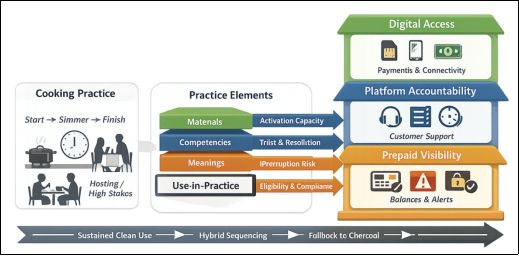
 Copy
Copy Download